Within-region correlation — false positive rate
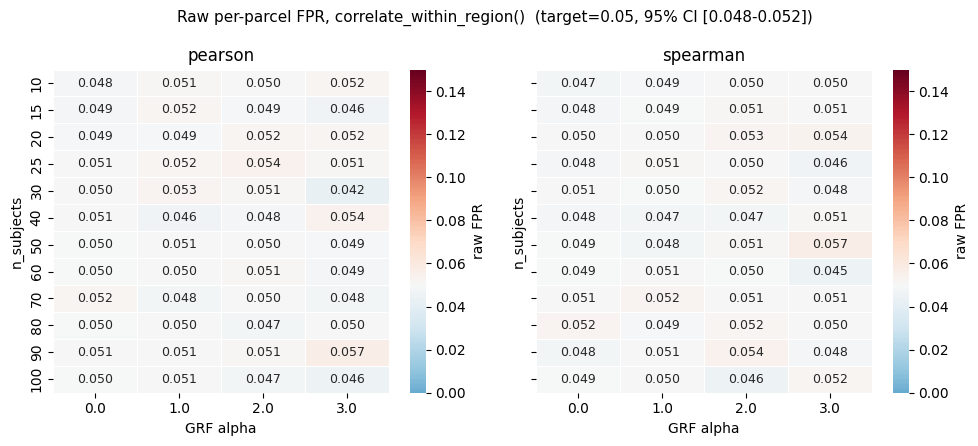
correlate_within_region() tests, independently within each parcel, whether subjects with a higher value in X also have a higher value in Y across the set of X/Y maps (e.g. subjects) – the transpose of `colocalize() <bench1-1_map_surrogates_fpr.ipynb>`__ (which correlate across parcels, within a subject/map). The null is generated by permuting map/subject identity, not by permuting parcels spatially – so, there is no obvious mechanism by which GRF spatial smoothness (alpha)
should affect calibration here. This notebook checks that prediction directly, using the same GRF (Gaussian Random Field) methodology as the spatial null methods benchmark (Markello & Misic, 2021), across a range of sample sizes (subjects) from 10 to 100.
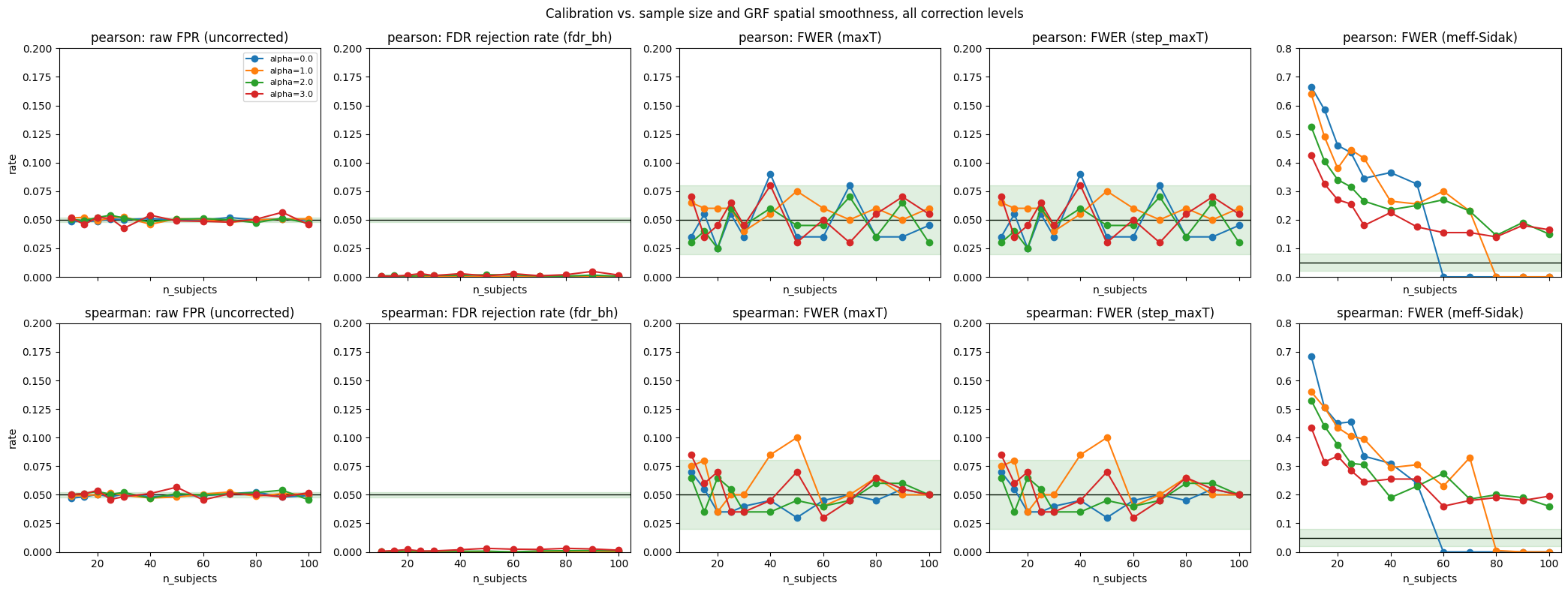
Because this is a mass-univariate test repeated once per parcel, this notebook also benchmarks the multiple-comparison correction options exposed by get_within_region_correlations(mc_method=...) – raw per-parcel FPR, family-wise error rate (FWER) under maxT/step_maxT, and false discovery rate (FDR) under fdr_bh.
Reference: Markello RD & Misic B (2021). Comparing spatial null models for brain maps. NeuroImage, 236, 118052. https://doi.org/10.1016/j.neuroimage.2021.118052
Note: this notebook is compute-intensive at large
N_REPS. It is designed to be pre-run. For a quick smoke-test, setN_REPS=10.
Benchmark design
For each (alpha, n_subjects, method) condition:
Draw ``N_REPS`` independent repetitions: for each, sample
2 * n_subjectsGRF maps from thealphapool without replacement (guaranteeing X and Y are independent draws, i.e. H0 – no true correlation – holds by construction), split inton_subjectsX-maps andn_subjectsY-maps. GRF’salpha > 0pool only has 1,000 maps, so atn_subjects=100(2*100=200maps needed per repetition) fewer thanN_REPSfully-disjoint repetitions are possible without exhausting the pool; once exhausted, the pool is reused with a fresh random draw (freshrngper repetition), which trades a small amount of between-repetition independence for being able to runN_REPSrepetitions at every sample size.Run
correlate_within_region(method=method, n_perm=N_PERM), thenget_within_region_correlations(mc_method=...)forfdr_bh/maxT/step_maxT, andget_within_region_correlations_omnibus(omnibus_stat=...)forrho/absrho/rho2.meffis not available throughget_within_region_correlations()– it is evaluated here via the low-level primitives (compute_meff/meff_sidak_correction) directly, purely to document why it’s excluded from the public API (see Configuration cell and Interpretation below).Pool all
N_REPS * n_parcelsraw p-values per condition for the raw FPR; for the FWER corrections (maxT/step_maxT/meff-Sidak) and the omnibus test, pool the any-rejection-per-repetition / single-test-per-repetition indicator instead (the right unit for a family-wise / single-test rate); forfdr_bh, pool the per-parcel rejections directly (FDR is already parcel-level, not family-level).
Condition grid
axis |
values |
|---|---|
alpha |
0.0, 1.0, 2.0, 3.0 |
n_subjects |
10, 15, 20, 25, 30, 40, 50, 60, 70, 80, 90, 100 |
method |
pearson, spearman |
correction |
none (raw), fdr_bh, maxT, step_maxT, meff (benchmark-only, not public API) |
omnibus_stat |
rho, absrho, rho2 |
[ ]:
# ── Configuration ─────────────────────────────────────────────────────────────
PARC   = "Yan200"
ALPHAS = [0.0, 1.0, 2.0, 3.0]
N_SUBJ_SIZES = [10, 15, 20, 25, 30, 40, 50, 60, 70, 80, 90, 100]
METHODS = ["pearson", "spearman"]
MC_METHODS = ["fdr_bh", "maxT", "step_maxT", "meff"]
OMNIBUS_STATS = ["rho", "absrho", "rho2"]  # get_within_region_correlations_omnibus()

N_REPS   = 200   # independent repetitions per condition
N_PERM   = 1000  # subject-permutation null size per correlate_within_region() call
P_THRESH = 0.05
SEED     = 42

import time
import numpy as np
import pandas as pd
import matplotlib.pyplot as plt
import seaborn as sn
from nispace import NiSpace
from nispace.datasets import fetch_reference
# meff is evaluated here via the low-level primitives directly, NOT through
# get_within_region_correlations(mc_method="meff") -- that option is deliberately
# rejected by the public API (see below): with n_subjects << n_parcels, the
# parcel-parcel correlation matrix it needs is rank-deficient and meff badly
# underestimates true effective dimensionality, giving an anti-conservative
# correction. This notebook is exactly what demonstrated that, so meff stays in the
# benchmark for documentation purposes, computed independently of the public API.
from nispace.stats.misc import compute_meff, meff_sidak_correction


def sample_disjoint(grf_alpha, n_needed, rng):
    """n_needed rows sampled without replacement from grf_alpha (reused across
    repetitions once the pool at this alpha is smaller than n_needed)."""
    n = len(grf_alpha)
    if n < n_needed:
        # pool exhausted at this alpha (e.g. alpha>0 has only 1000 maps); fall back to
        # sampling with replacement rather than failing -- see design note above
        idx = rng.choice(n, size=n_needed, replace=True)
    else:
        idx = rng.choice(n, size=n_needed, replace=False)
    return grf_alpha.iloc[idx]
[2]:
# ── Helper functions ──────────────────────────────────────────────────────────

def run_condition(grf_alpha, n_subj, method, rep_seed):
    """One (alpha, n_subjects, method) condition -> raw p pool + per-repetition
    any-rejection indicators for each FWER correction + per-parcel rejections for FDR
    + per-repetition rejection indicators for each omnibus_stat."""
    p_pool = []
    fwer_reject = {mc: [] for mc in ["maxT", "step_maxT", "meff"]}
    fdr_reject = []
    omnibus_reject = {os: [] for os in OMNIBUS_STATS}
    subj_labels = [f"s{i}" for i in range(n_subj)]

    for rep in range(N_REPS):
        rng = np.random.default_rng(rep_seed + rep)
        draw = sample_disjoint(grf_alpha, 2 * n_subj, rng)
        X, Y = draw.iloc[:n_subj], draw.iloc[n_subj:]
        # X and Y are intentionally independent GRF draws paired positionally as
        # "subjects" -- give them shared synthetic subject labels so
        # correlate_within_region() doesn't warn about their (unrelated) original
        # GRF map index labels not matching
        X = X.set_axis(subj_labels, axis=0)
        Y = Y.set_axis(subj_labels, axis=0)
        # parcellation=None: X/Y are already Yan200-parcellated (columns carry parcel
        # labels), so no parcellation object / dist_mat / spin_mat is needed or fetched
        # -- correlate_within_region() has no spatial-null dependency at all (see
        # project_lazy_parcellation_loading memory: fit() eagerly fetches those for a
        # real `parcellation=` regardless of use, ~100x slower per repetition here)
        nsp = NiSpace(x=X, y=Y, parcellation=None, standardize=False, verbose=False, n_proc=1)
        nsp.fit()
        nsp.correlate_within_region(method=method, n_perm=N_PERM, seed=rep_seed + rep)

        out = nsp.get_within_region_correlations()
        p_pool.extend(out["p"].values.ravel().tolist())

        for mc in ["maxT", "step_maxT"]:
            out_mc = nsp.get_within_region_correlations(mc_method=mc)
            fwer_reject[mc].append(bool((out_mc["p_corr"].values <= P_THRESH).any()))

        # meff: NOT via get_within_region_correlations(mc_method="meff") -- that
        # option is deliberately rejected by the public API (see Configuration cell).
        # Computed here directly for benchmarking/documentation purposes only. Same
        # parcels-as-rows orientation as get_within_region_correlations() used to
        # apply (matches compute_meff's use elsewhere: effective number of
        # independent items being corrected -- here, parcels, not subjects).
        meff = compute_meff(X.values.T)
        _, reject_meff = meff_sidak_correction(out["p"], meff, alpha=P_THRESH)
        fwer_reject["meff"].append(bool(reject_meff.values.any()))

        out_fdr = nsp.get_within_region_correlations(mc_method="fdr_bh")
        fdr_reject.extend((out_fdr["p_corr"].values <= P_THRESH).ravel().tolist())

        # omnibus: one p-value per repetition per omnibus_stat (single global test,
        # not per-parcel) -- reuses the same stored null, no extra permutations
        for os in OMNIBUS_STATS:
            out_omni = nsp.get_within_region_correlations_omnibus(omnibus_stat=os)
            omnibus_reject[os].append(out_omni["p"] < P_THRESH)

    return {
        "p_pool": np.array(p_pool),
        "fwer_reject": {mc: np.array(v) for mc, v in fwer_reject.items()},
        "fdr_reject": np.array(fdr_reject),
        "omnibus_reject": {os: np.array(v) for os, v in omnibus_reject.items()},
    }
[3]:
# ── Run all conditions ────────────────────────────────────────────────────────
n_pooled = N_REPS * 200  # n_parcels for Yan200
ci_lo = P_THRESH - 1.96 * np.sqrt(P_THRESH * (1 - P_THRESH) / n_pooled)
ci_hi = P_THRESH + 1.96 * np.sqrt(P_THRESH * (1 - P_THRESH) / n_pooled)
print(f"95% CI for raw-FPR pooled n={n_pooled}: [{ci_lo:.3f}, {ci_hi:.3f}]")

# one test per repetition (n=N_REPS) -- shared by FWER (any-rejection) and omnibus
# (single global test), both summarized as a per-repetition rejection rate
ci_lo_fwer = P_THRESH - 1.96 * np.sqrt(P_THRESH * (1 - P_THRESH) / N_REPS)
ci_hi_fwer = P_THRESH + 1.96 * np.sqrt(P_THRESH * (1 - P_THRESH) / N_REPS)
print(f"95% CI for FWER/omnibus pooled n={N_REPS}: [{ci_lo_fwer:.3f}, {ci_hi_fwer:.3f}]")

grf = fetch_reference("grf", parcellation=PARC, collection="ByAlpha", verbose=False)

records = []
cond_id = 0
t_start = time.time()

for alpha in ALPHAS:
    grf_a = grf.loc[f"alpha-{alpha:.1f}"]
    print(f"\n{'='*60}\nALPHA: {alpha}")

    for method in METHODS:
        for n_subj in N_SUBJ_SIZES:
            cond_id += 1
            t0 = time.time()
            out = run_condition(grf_a, n_subj, method, SEED + cond_id * 1000)

            raw_fpr = (out["p_pool"] < P_THRESH).mean()
            fdr_rate = out["fdr_reject"].mean()
            status = "OK" if ci_lo <= raw_fpr <= ci_hi else "!!"
            print(f"  {status} {method:8s} N={n_subj:<4d} alpha={alpha}  raw_FPR={raw_fpr:.3f}  "
                  f"FDR_rate={fdr_rate:.3f}  ({time.time()-t0:.0f}s, total {time.time()-t_start:.0f}s)")

            records.append({
                "alpha": alpha, "method": method, "n_subj": n_subj,
                "raw_fpr": raw_fpr, "n_pooled": len(out["p_pool"]),
                "fdr_rate": fdr_rate,
            })
            for mc in ["maxT", "step_maxT", "meff"]:
                records[-1][f"fwer_{mc}"] = out["fwer_reject"][mc].mean()
            for os in OMNIBUS_STATS:
                records[-1][f"omnibus_{os}"] = out["omnibus_reject"][os].mean()

results = pd.DataFrame(records)
print(f"\n{'='*60}\n{len(results)} conditions run in {time.time()-t_start:.0f}s total.")
95% CI for raw-FPR pooled n=40000: [0.048, 0.052]
95% CI for FWER/omnibus pooled n=200: [0.020, 0.080]

============================================================
ALPHA: 0.0
  OK pearson  N=10   alpha=0.0  raw_FPR=0.048  FDR_rate=0.000  (7s, total 7s)
  OK pearson  N=15   alpha=0.0  raw_FPR=0.049  FDR_rate=0.000  (8s, total 15s)
  OK pearson  N=20   alpha=0.0  raw_FPR=0.049  FDR_rate=0.000  (10s, total 25s)
  OK pearson  N=25   alpha=0.0  raw_FPR=0.051  FDR_rate=0.000  (11s, total 36s)
  OK pearson  N=30   alpha=0.0  raw_FPR=0.050  FDR_rate=0.000  (12s, total 47s)
  OK pearson  N=40   alpha=0.0  raw_FPR=0.051  FDR_rate=0.000  (14s, total 61s)
  OK pearson  N=50   alpha=0.0  raw_FPR=0.050  FDR_rate=0.000  (16s, total 77s)
  OK pearson  N=60   alpha=0.0  raw_FPR=0.050  FDR_rate=0.000  (18s, total 95s)
  OK pearson  N=70   alpha=0.0  raw_FPR=0.052  FDR_rate=0.000  (20s, total 116s)
  OK pearson  N=80   alpha=0.0  raw_FPR=0.050  FDR_rate=0.000  (23s, total 139s)
  OK pearson  N=90   alpha=0.0  raw_FPR=0.051  FDR_rate=0.000  (29s, total 168s)
  OK pearson  N=100  alpha=0.0  raw_FPR=0.050  FDR_rate=0.000  (32s, total 201s)
  !! spearman N=10   alpha=0.0  raw_FPR=0.047  FDR_rate=0.000  (7s, total 207s)
  OK spearman N=15   alpha=0.0  raw_FPR=0.048  FDR_rate=0.000  (8s, total 215s)
  OK spearman N=20   alpha=0.0  raw_FPR=0.050  FDR_rate=0.000  (9s, total 224s)
  OK spearman N=25   alpha=0.0  raw_FPR=0.048  FDR_rate=0.000  (10s, total 234s)
  OK spearman N=30   alpha=0.0  raw_FPR=0.051  FDR_rate=0.000  (11s, total 245s)
  OK spearman N=40   alpha=0.0  raw_FPR=0.048  FDR_rate=0.000  (13s, total 258s)
  OK spearman N=50   alpha=0.0  raw_FPR=0.049  FDR_rate=0.000  (15s, total 274s)
  OK spearman N=60   alpha=0.0  raw_FPR=0.049  FDR_rate=0.000  (17s, total 291s)
  OK spearman N=70   alpha=0.0  raw_FPR=0.051  FDR_rate=0.000  (19s, total 310s)
  !! spearman N=80   alpha=0.0  raw_FPR=0.052  FDR_rate=0.000  (21s, total 331s)
  OK spearman N=90   alpha=0.0  raw_FPR=0.048  FDR_rate=0.000  (27s, total 358s)
  OK spearman N=100  alpha=0.0  raw_FPR=0.049  FDR_rate=0.000  (29s, total 387s)

============================================================
ALPHA: 1.0
  OK pearson  N=10   alpha=1.0  raw_FPR=0.051  FDR_rate=0.000  (6s, total 393s)
  OK pearson  N=15   alpha=1.0  raw_FPR=0.052  FDR_rate=0.000  (8s, total 401s)
  OK pearson  N=20   alpha=1.0  raw_FPR=0.049  FDR_rate=0.000  (9s, total 411s)
  OK pearson  N=25   alpha=1.0  raw_FPR=0.052  FDR_rate=0.000  (10s, total 421s)
  !! pearson  N=30   alpha=1.0  raw_FPR=0.053  FDR_rate=0.000  (11s, total 433s)
  !! pearson  N=40   alpha=1.0  raw_FPR=0.046  FDR_rate=0.000  (14s, total 447s)
  OK pearson  N=50   alpha=1.0  raw_FPR=0.051  FDR_rate=0.000  (16s, total 462s)
  OK pearson  N=60   alpha=1.0  raw_FPR=0.050  FDR_rate=0.000  (18s, total 481s)
  !! pearson  N=70   alpha=1.0  raw_FPR=0.048  FDR_rate=0.000  (22s, total 503s)
  OK pearson  N=80   alpha=1.0  raw_FPR=0.050  FDR_rate=0.000  (23s, total 526s)
  OK pearson  N=90   alpha=1.0  raw_FPR=0.051  FDR_rate=0.000  (29s, total 555s)
  OK pearson  N=100  alpha=1.0  raw_FPR=0.051  FDR_rate=0.000  (32s, total 587s)
  OK spearman N=10   alpha=1.0  raw_FPR=0.049  FDR_rate=0.000  (7s, total 594s)
  OK spearman N=15   alpha=1.0  raw_FPR=0.049  FDR_rate=0.000  (8s, total 602s)
  OK spearman N=20   alpha=1.0  raw_FPR=0.050  FDR_rate=0.000  (9s, total 611s)
  OK spearman N=25   alpha=1.0  raw_FPR=0.051  FDR_rate=0.000  (10s, total 621s)
  OK spearman N=30   alpha=1.0  raw_FPR=0.050  FDR_rate=0.000  (11s, total 632s)
  !! spearman N=40   alpha=1.0  raw_FPR=0.047  FDR_rate=0.000  (14s, total 646s)
  OK spearman N=50   alpha=1.0  raw_FPR=0.048  FDR_rate=0.000  (15s, total 661s)
  OK spearman N=60   alpha=1.0  raw_FPR=0.051  FDR_rate=0.000  (17s, total 679s)
  !! spearman N=70   alpha=1.0  raw_FPR=0.052  FDR_rate=0.000  (21s, total 699s)
  OK spearman N=80   alpha=1.0  raw_FPR=0.049  FDR_rate=0.000  (22s, total 721s)
  OK spearman N=90   alpha=1.0  raw_FPR=0.051  FDR_rate=0.000  (27s, total 748s)
  OK spearman N=100  alpha=1.0  raw_FPR=0.050  FDR_rate=0.000  (29s, total 777s)

============================================================
ALPHA: 2.0
  OK pearson  N=10   alpha=2.0  raw_FPR=0.050  FDR_rate=0.001  (7s, total 784s)
  OK pearson  N=15   alpha=2.0  raw_FPR=0.049  FDR_rate=0.001  (8s, total 792s)
  OK pearson  N=20   alpha=2.0  raw_FPR=0.052  FDR_rate=0.001  (10s, total 801s)
  !! pearson  N=25   alpha=2.0  raw_FPR=0.054  FDR_rate=0.001  (11s, total 812s)
  OK pearson  N=30   alpha=2.0  raw_FPR=0.051  FDR_rate=0.001  (12s, total 824s)
  OK pearson  N=40   alpha=2.0  raw_FPR=0.048  FDR_rate=0.001  (14s, total 838s)
  OK pearson  N=50   alpha=2.0  raw_FPR=0.050  FDR_rate=0.002  (17s, total 855s)
  OK pearson  N=60   alpha=2.0  raw_FPR=0.051  FDR_rate=0.002  (19s, total 874s)
  OK pearson  N=70   alpha=2.0  raw_FPR=0.050  FDR_rate=0.001  (21s, total 894s)
  !! pearson  N=80   alpha=2.0  raw_FPR=0.047  FDR_rate=0.001  (23s, total 918s)
  OK pearson  N=90   alpha=2.0  raw_FPR=0.051  FDR_rate=0.002  (29s, total 946s)
  !! pearson  N=100  alpha=2.0  raw_FPR=0.047  FDR_rate=0.001  (33s, total 979s)
  OK spearman N=10   alpha=2.0  raw_FPR=0.050  FDR_rate=0.000  (7s, total 986s)
  OK spearman N=15   alpha=2.0  raw_FPR=0.051  FDR_rate=0.000  (8s, total 994s)
  !! spearman N=20   alpha=2.0  raw_FPR=0.053  FDR_rate=0.001  (9s, total 1003s)
  OK spearman N=25   alpha=2.0  raw_FPR=0.050  FDR_rate=0.000  (10s, total 1013s)
  OK spearman N=30   alpha=2.0  raw_FPR=0.052  FDR_rate=0.001  (11s, total 1024s)
  !! spearman N=40   alpha=2.0  raw_FPR=0.047  FDR_rate=0.001  (14s, total 1038s)
  OK spearman N=50   alpha=2.0  raw_FPR=0.051  FDR_rate=0.001  (15s, total 1053s)
  OK spearman N=60   alpha=2.0  raw_FPR=0.050  FDR_rate=0.000  (18s, total 1071s)
  OK spearman N=70   alpha=2.0  raw_FPR=0.051  FDR_rate=0.001  (19s, total 1091s)
  OK spearman N=80   alpha=2.0  raw_FPR=0.052  FDR_rate=0.001  (21s, total 1112s)
  !! spearman N=90   alpha=2.0  raw_FPR=0.054  FDR_rate=0.001  (23s, total 1135s)
  !! spearman N=100  alpha=2.0  raw_FPR=0.046  FDR_rate=0.001  (25s, total 1160s)

============================================================
ALPHA: 3.0
  OK pearson  N=10   alpha=3.0  raw_FPR=0.052  FDR_rate=0.001  (7s, total 1167s)
  !! pearson  N=15   alpha=3.0  raw_FPR=0.046  FDR_rate=0.000  (8s, total 1175s)
  OK pearson  N=20   alpha=3.0  raw_FPR=0.052  FDR_rate=0.002  (9s, total 1185s)
  OK pearson  N=25   alpha=3.0  raw_FPR=0.051  FDR_rate=0.003  (11s, total 1195s)
  !! pearson  N=30   alpha=3.0  raw_FPR=0.042  FDR_rate=0.001  (12s, total 1207s)
  !! pearson  N=40   alpha=3.0  raw_FPR=0.054  FDR_rate=0.003  (14s, total 1221s)
  OK pearson  N=50   alpha=3.0  raw_FPR=0.049  FDR_rate=0.001  (17s, total 1238s)
  OK pearson  N=60   alpha=3.0  raw_FPR=0.049  FDR_rate=0.003  (19s, total 1257s)
  OK pearson  N=70   alpha=3.0  raw_FPR=0.048  FDR_rate=0.001  (21s, total 1278s)
  OK pearson  N=80   alpha=3.0  raw_FPR=0.050  FDR_rate=0.002  (23s, total 1302s)
  !! pearson  N=90   alpha=3.0  raw_FPR=0.057  FDR_rate=0.005  (26s, total 1327s)
  !! pearson  N=100  alpha=3.0  raw_FPR=0.046  FDR_rate=0.002  (28s, total 1355s)
  OK spearman N=10   alpha=3.0  raw_FPR=0.050  FDR_rate=0.001  (7s, total 1362s)
  OK spearman N=15   alpha=3.0  raw_FPR=0.051  FDR_rate=0.001  (8s, total 1370s)
  !! spearman N=20   alpha=3.0  raw_FPR=0.054  FDR_rate=0.002  (9s, total 1379s)
  !! spearman N=25   alpha=3.0  raw_FPR=0.046  FDR_rate=0.001  (10s, total 1389s)
  OK spearman N=30   alpha=3.0  raw_FPR=0.048  FDR_rate=0.001  (11s, total 1400s)
  OK spearman N=40   alpha=3.0  raw_FPR=0.051  FDR_rate=0.002  (14s, total 1414s)
  !! spearman N=50   alpha=3.0  raw_FPR=0.057  FDR_rate=0.003  (16s, total 1429s)
  !! spearman N=60   alpha=3.0  raw_FPR=0.045  FDR_rate=0.002  (18s, total 1447s)
  OK spearman N=70   alpha=3.0  raw_FPR=0.051  FDR_rate=0.002  (20s, total 1467s)
  OK spearman N=80   alpha=3.0  raw_FPR=0.050  FDR_rate=0.003  (21s, total 1488s)
  OK spearman N=90   alpha=3.0  raw_FPR=0.048  FDR_rate=0.003  (23s, total 1511s)
  OK spearman N=100  alpha=3.0  raw_FPR=0.052  FDR_rate=0.002  (27s, total 1539s)

============================================================
96 conditions run in 1539s total.
Results
[4]:
# Heatmap: raw FPR per (n_subj × alpha), one panel per method
fig, axes = plt.subplots(1, len(METHODS), figsize=(5*len(METHODS), 4.5), sharey=True)
for ax, method in zip(np.atleast_1d(axes), METHODS):
    sub = results[results.method == method]
    piv = sub.pivot(index="n_subj", columns="alpha", values="raw_fpr")
    sn.heatmap(piv, ax=ax, annot=True, fmt=".3f", annot_kws={"size": 9}, cmap="RdBu_r",
               vmin=0, vmax=0.15, center=P_THRESH, cbar_kws={"label": "raw FPR"}, linewidths=0.5)
    ax.set_title(method)
    ax.set_xlabel("GRF alpha")
    ax.set_ylabel("n_subjects")
fig.suptitle(f"Raw per-parcel FPR, correlate_within_region()  "
             f"(target={P_THRESH}, 95% CI [{ci_lo:.3f}-{ci_hi:.3f}])", fontsize=11)
plt.tight_layout()
[5]:
# Line plots: all 5 correction levels vs n_subjects, one line per alpha, split by method.
# meff gets its own (wider) y-scale -- see Interpretation, it's badly miscalibrated here
# and would otherwise be clipped/invisible on the same 0-0.2 scale as the others.
METRICS = [
    ("raw_fpr", "raw FPR (uncorrected)", (ci_lo, ci_hi), (0, 0.2)),
    ("fdr_rate", "FDR rejection rate (fdr_bh)", (ci_lo, ci_hi), (0, 0.2)),
    ("fwer_maxT", "FWER (maxT)", (ci_lo_fwer, ci_hi_fwer), (0, 0.2)),
    ("fwer_step_maxT", "FWER (step_maxT)", (ci_lo_fwer, ci_hi_fwer), (0, 0.2)),
    ("fwer_meff", "FWER (meff-Sidak)", (ci_lo_fwer, ci_hi_fwer), (0, 0.8)),
]

fig, axes = plt.subplots(len(METHODS), len(METRICS), figsize=(4.2*len(METRICS), 4*len(METHODS)),
                          sharex=True)
if len(METHODS) == 1:
    axes = axes[np.newaxis, :]

for row, method in enumerate(METHODS):
    sub = results[results.method == method]
    for col, (col_name, ylabel, ci, ylim) in enumerate(METRICS):
        ax = axes[row, col]
        for alpha, grp in sub.groupby("alpha"):
            g = grp.sort_values("n_subj")
            ax.plot(g["n_subj"], g[col_name], marker="o", label=f"alpha={alpha}")
        ax.axhline(P_THRESH, color="k", lw=1, zorder=0)
        ax.axhspan(*ci, alpha=0.12, color="green", zorder=0)
        ax.set_title(f"{method}: {ylabel}")
        ax.set_xlabel("n_subjects")
        ax.set_ylim(*ylim)
        if col == 0:
            ax.set_ylabel("rate")
        if row == 0 and col == 0:
            ax.legend(fontsize=8)
fig.suptitle("Calibration vs. sample size and GRF spatial smoothness, all correction levels",
             fontsize=12)
plt.tight_layout()
[6]:
# p-value histograms at n_subj=10 (highest-risk small-N regime), pooled across alpha, per method
fig, axes = plt.subplots(1, len(METHODS), figsize=(5*len(METHODS), 3.5))
for ax, method in zip(np.atleast_1d(axes), METHODS):
    # `results` only stores summary FPR, not the raw pooled p-array -- rerun once,
    # cheaply, purely for the histogram
    ps = []
    for alpha in ALPHAS:
        grf_a = grf.loc[f"alpha-{alpha:.1f}"]
        out = run_condition(grf_a, 10, method, SEED + 999_000)
        ps.append(out["p_pool"])
    ps = np.concatenate(ps)
    ax.hist(ps, bins=20, range=(0, 1), color="steelblue", edgecolor="white")
    ax.axhline(len(ps) / 20, color="k", ls="--", lw=1, label="uniform expectation")
    ax.set_title(f"{method}, n_subj=10 (pooled across alpha)")
    ax.set_xlabel("raw p-value")
    ax.legend(fontsize=8)
axes[0].set_ylabel("count")
plt.tight_layout()
Omnibus test
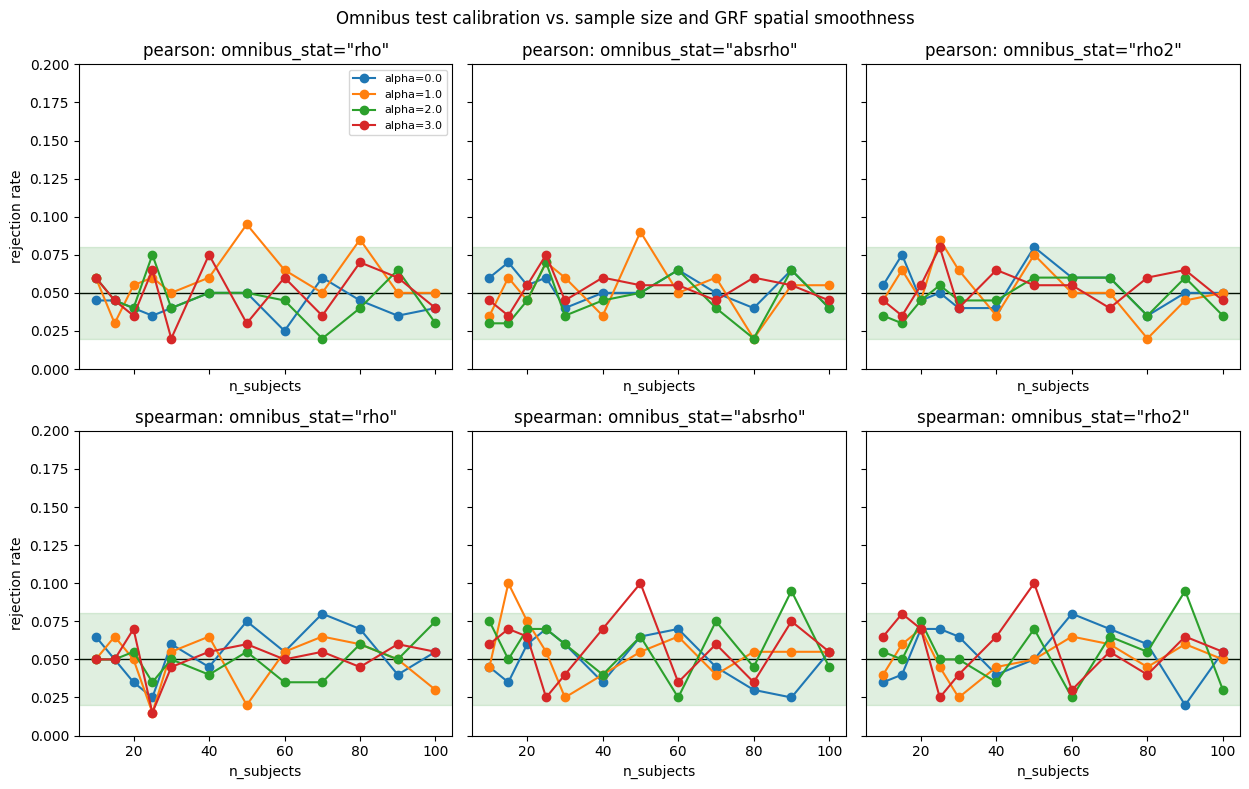
get_within_region_correlations_omnibus() collapses all per-parcel rho into one number per repetition (omnibus_stat="rho"/"absrho"/"rho2", see docstring) and tests it against the same subject-permutation null, aggregated the same way – one p-value for the whole condition instead of one per parcel. Unlike the FDR/FWER panels above (which summarize many per-parcel tests), this is genuinely one test per repetition, so its expected calibration target is the same as raw
FPR/FWER: a rejection rate of P_THRESH under this benchmark’s true global null, using the FWER-style CI (ci_lo_fwer/ci_hi_fwer, n=N_REPS) computed above.
[7]:
# Line plots: omnibus rejection rate vs n_subjects, one line per alpha, one panel per
# omnibus_stat, split by method (rows)
fig, axes = plt.subplots(len(METHODS), len(OMNIBUS_STATS),
                          figsize=(4.2*len(OMNIBUS_STATS), 4*len(METHODS)), sharex=True, sharey=True)
if len(METHODS) == 1:
    axes = axes[np.newaxis, :]

for row, method in enumerate(METHODS):
    sub = results[results.method == method]
    for col, os_ in enumerate(OMNIBUS_STATS):
        ax = axes[row, col]
        for alpha, grp in sub.groupby("alpha"):
            g = grp.sort_values("n_subj")
            ax.plot(g["n_subj"], g[f"omnibus_{os_}"], marker="o", label=f"alpha={alpha}")
        ax.axhline(P_THRESH, color="k", lw=1, zorder=0)
        ax.axhspan(ci_lo_fwer, ci_hi_fwer, alpha=0.12, color="green", zorder=0)
        ax.set_title(f"{method}: omnibus_stat=\"{os_}\"")
        ax.set_xlabel("n_subjects")
        ax.set_ylim(0, 0.2)
        if col == 0:
            ax.set_ylabel("rejection rate")
        if row == 0 and col == 0:
            ax.legend(fontsize=8)
fig.suptitle("Omnibus test calibration vs. sample size and GRF spatial smoothness", fontsize=12)
plt.tight_layout()
Interpretation
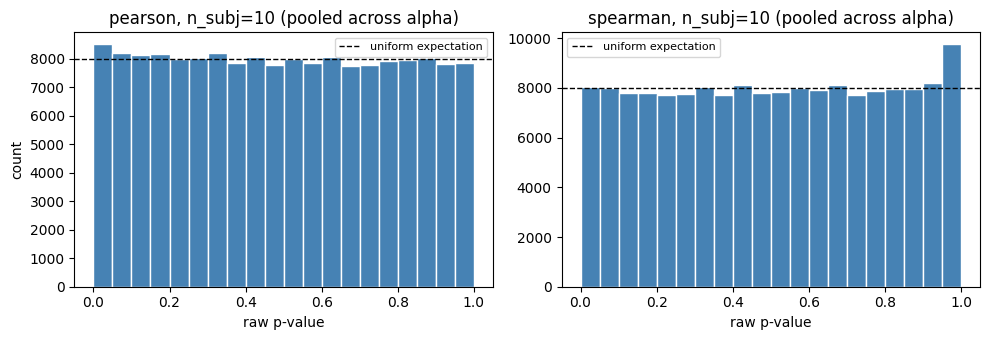
Raw FPR confirms the central hypothesis: it is alpha-invariant. Across all n_subjects (10–100) and GRF spatial smoothness (alpha 0–3), raw per-parcel FPR stays tight around nominal 0.05, for both pearson and spearman. The null here comes from permuting subject identity, not from randomizing parcels spatially, so spatial autocorrelation in X/Y has no mechanism to leak into calibration here.
``fdr_bh`` near zero is expected, not a problem. Under a complete null, BH’s actual guarantee collapses to P(any rejection) <= alpha – an FWER-like quantity, not “reject ~5% of parcels.” It would behave like a normal per-parcel-rate procedure under a realistic mixture of true and null parcels, which this FPR-only benchmark doesn’t include.
``maxT``/``step_maxT`` are both well-calibrated and agree exactly on FWER. Each takes a per-permutation maximum |rho| across all parcels and compares every parcel’s observed |rho| against that shared null, so whatever correlation actually exists between parcels’ test statistics (spatial autocorrelation included) is preserved automatically – no independence assumption, unlike bonferroni/fdr_bh. Since the FWER metric here (“was any parcel rejected”) is entirely determined by
the single most extreme parcel, and step_maxT’s top-ranked computation is identical to maxT’s by construction, the two can never disagree on it – they’d only diverge on power (rejecting additional true positives after the first).
``meff`` is excluded from the public API, and this notebook is why. Sidak correction via an effective-number-of-independent-tests estimate needs a parcel-parcel correlation matrix built from n_subjects observations – far fewer than n_parcels (200) here – so the estimate is rank-deficient and systematically underestimates true dimensionality, giving an anti-conservative correction (family-wise error well above nominal across the tested range, improving but not reaching nominal even
at the largest N). maxT/step_maxT share the exact same prerequisite (n_perm > 0) at no extra cost, so there’s no real tradeoff in preferring them; get_within_region_correlations(mc_method="meff") raises rather than silently returning this.
The omnibus test (``get_within_region_correlations_omnibus()``) is expected to be alpha-invariant and calibrated near nominal for the same structural reason as raw/maxT/ step_maxT – it reuses the identical subject-permutation null, just aggregated across parcels into one number per repetition instead of tested per parcel. All three omnibus_stat choices (rho, absrho, rho2) are single tests under this benchmark’s true global null, so each should show a rejection rate near
P_THRESH regardless of alpha, n_subjects, or method.
The actual validity risk isn’t spatial structure – it’s a shared confound. Subject-permutation preserves X’s and Y’s entire internal structure untouched (only subject-to-subject pairing is reshuffled), so neither within-map spatial autocorrelation nor between-subject intercorrelation threatens raw/maxT/step_maxT calibration, which is exactly what the alpha-invariance above demonstrates. What none of this protects against is a subject-level variable correlated with both X’s and
Y’s between-subject variation (age, motion, site) – that breaks the exchangeability the permutation null relies on, not just “adds correlation among tests.” Addressing that needs a subject-indexed partial-correlation extension (regress the confound out before testing), which we add as a feature in the future.