FreeSurfer cortical thickness colocalizations in subjects with fragile X syndrome#
This notebook will demonstrate how to perform a group comparison based on FreeSurfer output. For that, we will start with actual FreeSurfer output folders, to make translation to your own data as easy as possible.
Fragile X syndrome (FrX), as a genetic disorder, can be expected to have strong effects on cortical thickness, likely in some brain regions more than in others. These characteristics make it interesting for demonstration of colocalization analysis.
We will first download the data from OpenNeuro to a local folder. If you only want to check out how to work with cortical FreeSurfer output, and already have tabulated data for either the coarser Desikan-Killiany (“aparc”, 34 parcels per hemisphere) or the finer Destrieux parcellation (“aparc.a2009s”, 74 parcels per hemisphere), you might want to jump directly to the analysis here.
[1]:
# general imports
from pathlib import Path
import numpy as np
import pandas as pd
import matplotlib.pyplot as plt
# monkey patch to make progress bars show as ASCII instead of as widgets
import tqdm.notebook
tqdm.notebook.tqdm = tqdm.tqdm
tqdm = tqdm.notebook.tqdm
[2]:
# load local nispace, for testing
# COMMENT THIS OUT IF YOU RUN THIS LOCALLY AFTER INSTALLING NISPACE
import sys
sys.path.append("/Users/llotter/projects/nispace/")
Data preparation: Download a FreeSurfer sample from OpenNeuro#
Although, we will use only a small part of these data, we will download the complete freesurfer/sub-{}/stats folders for each subject as we would have after we processed a dataset with FreeSurfer. It’s only table files, so a few MB overall.
This is a dictionary of the URLs of the files we want to download. Format: {"url": local_path}
[3]:
from nispace.io import read_json
# get the directory of this notebook
notebook_dir = Path().absolute()
# read the URLs from the JSON file
urls = read_json(notebook_dir / "urls_ds004654-1.0.1.json")
#urls
Download all the files. If run like this, the code will download the data into: directory_of_this_notebook/ds004654-1.0.1/
[4]:
from nispace.utils.utils_datasets import download
# this will be our dataset directory
dataset_dir = notebook_dir / "ds004654-1.0.1"
# iterate over the URLs and download the files
for url, fp in tqdm(urls.items(), desc="Downloading files..."):
fp = notebook_dir / fp
# download the file only if it does not exist already
if not fp.exists():
fp.parent.mkdir(parents=True, exist_ok=True)
download(url, fp)
Downloading files...: 100%|██████████| 595/595 [00:00<00:00, 134788.60it/s]
Fetch sample data#
Subject characteristics#
This is a BIDS dataset, so there is a participants.tsv file that contains subject characteristics.
[5]:
df_participants = pd.read_table(dataset_dir / "participants.tsv", index_col=0)
# This is what the dataframe looks like:
print("participants.tsv:")
display(df_participants.head(5))
# That's our two groups:
print("Group statistics:")
df_participants.groupby("diagnosis").describe()
participants.tsv:
| diagnosis | age | sex | |
|---|---|---|---|
| participant_id | |||
| sub-HM02 | HC | 20 | M |
| sub-HM03 | HC | 22 | M |
| sub-HM05 | HC | 23 | M |
| sub-HM06 | FrX | 23 | M |
| sub-HM07 | HC | 20 | M |
Group statistics:
[5]:
| age | ||||||||
|---|---|---|---|---|---|---|---|---|
| count | mean | std | min | 25% | 50% | 75% | max | |
| diagnosis | ||||||||
| FrX | 12.0 | 20.75 | 2.179449 | 18.0 | 19.0 | 20.5 | 23.0 | 24.0 |
| HC | 16.0 | 21.75 | 1.612452 | 19.0 | 20.0 | 22.0 | 23.0 | 24.0 |
Collect FreeSurfer data#
For now, we will use standard FreeSurfer output from the cortical segmentation. The two standard parcellations are Desikan-Killiany and Destrieux. We assume that you have FreeSurfer installed on your system and accessible from the command line, so we can use the dedicated FreeSurfer command aparcstats2table to gather segmentation output across multiple subjects.
One has to run the command separately for each hemisphere and parcellation: Desikan-Killiany: “aparc” and Destrieux: “aparc.a2009s”.
[6]:
import os
import subprocess
# set FreeSurfer's SUBJECTS_DIR to our datasets FreeSurfer output directory
os.environ["SUBJECTS_DIR"] = str(dataset_dir / "derivatives" / "freesurfer")
# we have to run the command separately for each hemisphere and parcellation
for hemi in ["lh", "rh"]:
for parc in ["aparc", "aparc.a2009s"]:
# this will be our output table file
aparcstats_file = dataset_dir / f"stats_{parc}_{hemi}.tsv"
# assemble the command (replace "thickness" with "volume" or "area" to get the other measures)
cmd = [
"aparcstats2table",
"--subjects", " ".join(df_participants.index),
"--hemi", hemi,
"--parc", parc,
"--meas", "thickness",
"--tablefile", str(aparcstats_file)
]
cmd = " ".join(cmd)
print(cmd)
# run the command
subprocess.run(cmd, shell=True)
aparcstats2table --subjects sub-HM02 sub-HM03 sub-HM05 sub-HM06 sub-HM07 sub-HM08 sub-HM09 sub-HM10 sub-HM15 sub-HM16 sub-HM17 sub-HM18 sub-HM19 sub-HM21 sub-HM22 sub-HM24 sub-HM25 sub-HM28 sub-HM29 sub-HM30 sub-HM31 sub-HM32 sub-HM35 sub-HM36 sub-HM37 sub-HM38 sub-HM39 sub-HM40 --hemi lh --parc aparc --meas thickness --tablefile /Users/llotter/projects/nispace/docs/nb_examples/ds004654-1.0.1/stats_aparc_lh.tsv
SUBJECTS_DIR : /Users/llotter/projects/nispace/docs/nb_examples/ds004654-1.0.1/derivatives/freesurfer
Parsing the .stats files
Building the table..
Writing the table to /Users/llotter/projects/nispace/docs/nb_examples/ds004654-1.0.1/stats_aparc_lh.tsv
aparcstats2table --subjects sub-HM02 sub-HM03 sub-HM05 sub-HM06 sub-HM07 sub-HM08 sub-HM09 sub-HM10 sub-HM15 sub-HM16 sub-HM17 sub-HM18 sub-HM19 sub-HM21 sub-HM22 sub-HM24 sub-HM25 sub-HM28 sub-HM29 sub-HM30 sub-HM31 sub-HM32 sub-HM35 sub-HM36 sub-HM37 sub-HM38 sub-HM39 sub-HM40 --hemi lh --parc aparc.a2009s --meas thickness --tablefile /Users/llotter/projects/nispace/docs/nb_examples/ds004654-1.0.1/stats_aparc.a2009s_lh.tsv
SUBJECTS_DIR : /Users/llotter/projects/nispace/docs/nb_examples/ds004654-1.0.1/derivatives/freesurfer
Parsing the .stats files
Building the table..
Writing the table to /Users/llotter/projects/nispace/docs/nb_examples/ds004654-1.0.1/stats_aparc.a2009s_lh.tsv
aparcstats2table --subjects sub-HM02 sub-HM03 sub-HM05 sub-HM06 sub-HM07 sub-HM08 sub-HM09 sub-HM10 sub-HM15 sub-HM16 sub-HM17 sub-HM18 sub-HM19 sub-HM21 sub-HM22 sub-HM24 sub-HM25 sub-HM28 sub-HM29 sub-HM30 sub-HM31 sub-HM32 sub-HM35 sub-HM36 sub-HM37 sub-HM38 sub-HM39 sub-HM40 --hemi rh --parc aparc --meas thickness --tablefile /Users/llotter/projects/nispace/docs/nb_examples/ds004654-1.0.1/stats_aparc_rh.tsv
SUBJECTS_DIR : /Users/llotter/projects/nispace/docs/nb_examples/ds004654-1.0.1/derivatives/freesurfer
Parsing the .stats files
Building the table..
Writing the table to /Users/llotter/projects/nispace/docs/nb_examples/ds004654-1.0.1/stats_aparc_rh.tsv
aparcstats2table --subjects sub-HM02 sub-HM03 sub-HM05 sub-HM06 sub-HM07 sub-HM08 sub-HM09 sub-HM10 sub-HM15 sub-HM16 sub-HM17 sub-HM18 sub-HM19 sub-HM21 sub-HM22 sub-HM24 sub-HM25 sub-HM28 sub-HM29 sub-HM30 sub-HM31 sub-HM32 sub-HM35 sub-HM36 sub-HM37 sub-HM38 sub-HM39 sub-HM40 --hemi rh --parc aparc.a2009s --meas thickness --tablefile /Users/llotter/projects/nispace/docs/nb_examples/ds004654-1.0.1/stats_aparc.a2009s_rh.tsv
SUBJECTS_DIR : /Users/llotter/projects/nispace/docs/nb_examples/ds004654-1.0.1/derivatives/freesurfer
Parsing the .stats files
Building the table..
Writing the table to /Users/llotter/projects/nispace/docs/nb_examples/ds004654-1.0.1/stats_aparc.a2009s_rh.tsv
Get Euler number as a quality covariate#
The Euler number is quite a good quality measure for structural MRI scans. FreeSurfer outputs it only via the asegstats2table command.
[7]:
# this will be our output table file
asegstats_file = dataset_dir / f"stats_aseg.tsv"
# assemble the command
cmd = [
"asegstats2table",
"--subjects", " ".join(df_participants.index),
"--tablefile", str(asegstats_file)
]
cmd = " ".join(cmd)
print(cmd)
# run the command
subprocess.run(cmd, shell=True)
asegstats2table --subjects sub-HM02 sub-HM03 sub-HM05 sub-HM06 sub-HM07 sub-HM08 sub-HM09 sub-HM10 sub-HM15 sub-HM16 sub-HM17 sub-HM18 sub-HM19 sub-HM21 sub-HM22 sub-HM24 sub-HM25 sub-HM28 sub-HM29 sub-HM30 sub-HM31 sub-HM32 sub-HM35 sub-HM36 sub-HM37 sub-HM38 sub-HM39 sub-HM40 --tablefile /Users/llotter/projects/nispace/docs/nb_examples/ds004654-1.0.1/stats_aseg.tsv
SUBJECTS_DIR : /Users/llotter/projects/nispace/docs/nb_examples/ds004654-1.0.1/derivatives/freesurfer
Parsing the .stats files
Building the table..
Writing the table to /Users/llotter/projects/nispace/docs/nb_examples/ds004654-1.0.1/stats_aseg.tsv
[7]:
CompletedProcess(args='asegstats2table --subjects sub-HM02 sub-HM03 sub-HM05 sub-HM06 sub-HM07 sub-HM08 sub-HM09 sub-HM10 sub-HM15 sub-HM16 sub-HM17 sub-HM18 sub-HM19 sub-HM21 sub-HM22 sub-HM24 sub-HM25 sub-HM28 sub-HM29 sub-HM30 sub-HM31 sub-HM32 sub-HM35 sub-HM36 sub-HM37 sub-HM38 sub-HM39 sub-HM40 --tablefile /Users/llotter/projects/nispace/docs/nb_examples/ds004654-1.0.1/stats_aseg.tsv', returncode=0)
Load FreeSurfer stats tables#
Now we load the FreeSurfer stats tables into pandas dataframes. We will combine left and right hemisphere data into one dataframe (L -> R). This is the way NiSpace works with bilateral surface data.
Desikan-Killiany parcellation#
We’ll start with the Desikan-Killiany parcellation. Load left and right dataframes, drop unnecessary columns, and concatenate them.
[8]:
# load left and right hemisphere data
df_desikan_lh = pd.read_table(dataset_dir / "stats_aparc_lh.tsv", index_col=0)
df_desikan_rh = pd.read_table(dataset_dir / "stats_aparc_rh.tsv", index_col=0)
# display the first 5 rows of left hemisphere
print("Desikan-Killiany left hemisphere: shape:", df_desikan_lh.shape)
display(df_desikan_lh.head(5))
# There's 3 columns we dont need for our core analysis: {lh|rh}_MeanThickness_thickness, BrainSegVolNotVent, eTIV
df_desikan_lh = df_desikan_lh.drop(columns=["lh_MeanThickness_thickness", "BrainSegVolNotVent", "eTIV"])
df_desikan_rh = df_desikan_rh.drop(columns=["rh_MeanThickness_thickness", "BrainSegVolNotVent", "eTIV"])
print("shape after dropping columns:", df_desikan_lh.shape)
# concatenate left and right hemisphere
df_desikan = pd.concat([df_desikan_lh, df_desikan_rh], axis=1)
print("Shape after concatenation:", df_desikan.shape)
Desikan-Killiany left hemisphere: shape: (28, 37)
| lh_bankssts_thickness | lh_caudalanteriorcingulate_thickness | lh_caudalmiddlefrontal_thickness | lh_cuneus_thickness | lh_entorhinal_thickness | lh_fusiform_thickness | lh_inferiorparietal_thickness | lh_inferiortemporal_thickness | lh_isthmuscingulate_thickness | lh_lateraloccipital_thickness | ... | lh_superiorparietal_thickness | lh_superiortemporal_thickness | lh_supramarginal_thickness | lh_frontalpole_thickness | lh_temporalpole_thickness | lh_transversetemporal_thickness | lh_insula_thickness | lh_MeanThickness_thickness | BrainSegVolNotVent | eTIV | |
|---|---|---|---|---|---|---|---|---|---|---|---|---|---|---|---|---|---|---|---|---|---|
| lh.aparc.thickness | |||||||||||||||||||||
| sub-HM02 | 2.842 | 2.451 | 2.708 | 2.058 | 3.014 | 2.963 | 2.416 | 3.078 | 2.492 | 2.088 | ... | 2.247 | 3.139 | 2.680 | 3.043 | 3.743 | 2.909 | 3.176 | 2.66845 | 1498381.0 | 1.852958e+06 |
| sub-HM03 | 2.639 | 2.769 | 2.789 | 2.091 | 3.786 | 2.999 | 2.719 | 3.105 | 2.408 | 2.227 | ... | 2.357 | 3.148 | 2.766 | 2.527 | 4.229 | 2.946 | 3.040 | 2.74607 | 1304548.0 | 1.609761e+06 |
| sub-HM05 | 2.440 | 2.532 | 2.647 | 1.938 | 2.957 | 2.735 | 2.598 | 2.660 | 2.326 | 2.087 | ... | 2.149 | 3.138 | 2.573 | 2.994 | 3.825 | 2.741 | 3.121 | 2.55060 | 1422817.0 | 1.525428e+06 |
| sub-HM06 | 2.538 | 2.442 | 2.730 | 2.098 | 4.131 | 3.027 | 2.544 | 2.958 | 2.263 | 2.248 | ... | 2.373 | 3.326 | 2.663 | 2.987 | 4.294 | 2.768 | 3.416 | 2.67984 | 1473457.0 | 1.950892e+06 |
| sub-HM07 | 2.576 | 2.478 | 2.545 | 1.953 | 2.741 | 2.590 | 2.463 | 2.581 | 2.590 | 2.166 | ... | 2.107 | 2.949 | 2.610 | 2.449 | 3.909 | 2.198 | 2.579 | 2.49447 | 1481353.0 | 1.856110e+06 |
5 rows × 37 columns
shape after dropping columns: (28, 34)
Shape after concatenation: (28, 68)
Destrieux parcellation#
We’ll do the same thing for the Destrieux parcellation.
[9]:
# load left and right hemisphere data
df_destrieux_lh = pd.read_table(dataset_dir / "stats_aparc.a2009s_lh.tsv", index_col=0)
df_destrieux_rh = pd.read_table(dataset_dir / "stats_aparc.a2009s_rh.tsv", index_col=0)
# display the first 5 rows of left hemisphere
print("Destrieux left hemisphere: shape:", df_destrieux_lh.shape)
display(df_destrieux_lh.head(5))
# drop the unnecessary columns
df_destrieux_lh = df_destrieux_lh.drop(columns=["lh_MeanThickness_thickness", "BrainSegVolNotVent", "eTIV"])
df_destrieux_rh = df_destrieux_rh.drop(columns=["rh_MeanThickness_thickness", "BrainSegVolNotVent", "eTIV"])
print("shape after dropping columns:", df_destrieux_lh.shape)
# concatenate left and right hemisphere
df_destrieux = pd.concat([df_destrieux_lh, df_destrieux_rh], axis=1)
print("Shape after concatenation:", df_destrieux.shape)
Destrieux left hemisphere: shape: (28, 77)
| lh_G_and_S_frontomargin_thickness | lh_G_and_S_occipital_inf_thickness | lh_G_and_S_paracentral_thickness | lh_G_and_S_subcentral_thickness | lh_G_and_S_transv_frontopol_thickness | lh_G_and_S_cingul-Ant_thickness | lh_G_and_S_cingul-Mid-Ant_thickness | lh_G_and_S_cingul-Mid-Post_thickness | lh_G_cingul-Post-dorsal_thickness | lh_G_cingul-Post-ventral_thickness | ... | lh_S_precentral-inf-part_thickness | lh_S_precentral-sup-part_thickness | lh_S_suborbital_thickness | lh_S_subparietal_thickness | lh_S_temporal_inf_thickness | lh_S_temporal_sup_thickness | lh_S_temporal_transverse_thickness | lh_MeanThickness_thickness | BrainSegVolNotVent | eTIV | |
|---|---|---|---|---|---|---|---|---|---|---|---|---|---|---|---|---|---|---|---|---|---|
| lh.aparc.a2009s.thickness | |||||||||||||||||||||
| sub-HM02 | 2.669 | 2.045 | 2.278 | 2.818 | 2.824 | 2.771 | 2.922 | 2.680 | 3.208 | 3.248 | ... | 2.544 | 2.530 | 2.194 | 2.284 | 2.820 | 2.673 | 2.828 | 2.66845 | 1498381.0 | 1.852958e+06 |
| sub-HM03 | 2.564 | 2.214 | 2.569 | 3.028 | 2.472 | 3.122 | 3.057 | 2.928 | 3.142 | 3.013 | ... | 2.795 | 2.887 | 2.478 | 2.437 | 2.658 | 2.737 | 2.699 | 2.74607 | 1304548.0 | 1.609761e+06 |
| sub-HM05 | 2.247 | 2.427 | 2.347 | 2.733 | 2.791 | 2.751 | 2.916 | 2.743 | 2.778 | 2.696 | ... | 2.828 | 2.641 | 2.301 | 2.459 | 2.496 | 2.666 | 2.621 | 2.55060 | 1422817.0 | 1.525428e+06 |
| sub-HM06 | 2.508 | 2.372 | 2.502 | 3.089 | 2.841 | 2.806 | 2.725 | 2.787 | 3.341 | 2.398 | ... | 2.778 | 2.465 | 2.627 | 2.415 | 2.574 | 2.723 | 2.623 | 2.67984 | 1473457.0 | 1.950892e+06 |
| sub-HM07 | 2.323 | 2.329 | 2.557 | 2.778 | 2.428 | 2.649 | 2.808 | 2.602 | 3.128 | 2.865 | ... | 2.539 | 2.597 | 2.401 | 2.417 | 2.289 | 2.570 | 2.454 | 2.49447 | 1481353.0 | 1.856110e+06 |
5 rows × 77 columns
shape after dropping columns: (28, 74)
Shape after concatenation: (28, 148)
Euler number and eTIV as covariates#
Euler number is stored as “SurfaceHoles”. We will furthermore extract total intracranial volume (eTIV) data.
[10]:
df_aseg = pd.read_table(dataset_dir / "stats_aseg.tsv", index_col=0)
df_aseg.head()
# We'll save them in our participants table
df_participants["euler_number"] = df_aseg["SurfaceHoles"].values
df_participants["eTIV"] = df_aseg["EstimatedTotalIntraCranialVol"].values
# lets see some descriptive statistics
df_participants.describe()
[10]:
| age | euler_number | eTIV | |
|---|---|---|---|
| count | 28.000000 | 28.000000 | 2.800000e+01 |
| mean | 21.321429 | 40.000000 | 1.887269e+06 |
| std | 1.906200 | 12.719189 | 1.965039e+05 |
| min | 18.000000 | 16.000000 | 1.525428e+06 |
| 25% | 20.000000 | 31.000000 | 1.738014e+06 |
| 50% | 21.500000 | 39.500000 | 1.943034e+06 |
| 75% | 23.000000 | 48.250000 | 2.012314e+06 |
| max | 24.000000 | 67.000000 | 2.260434e+06 |
Colocalization#
Now to the main analysis. If you jumped to here, make sure that your data looks like this: (n_subjects x n_parcels)
[11]:
print("For Desikan-Killiany parcellation:")
display(df_desikan.head(3))
print("For Destrieux parcellation:")
display(df_destrieux.head(3))
For Desikan-Killiany parcellation:
| lh_bankssts_thickness | lh_caudalanteriorcingulate_thickness | lh_caudalmiddlefrontal_thickness | lh_cuneus_thickness | lh_entorhinal_thickness | lh_fusiform_thickness | lh_inferiorparietal_thickness | lh_inferiortemporal_thickness | lh_isthmuscingulate_thickness | lh_lateraloccipital_thickness | ... | rh_rostralanteriorcingulate_thickness | rh_rostralmiddlefrontal_thickness | rh_superiorfrontal_thickness | rh_superiorparietal_thickness | rh_superiortemporal_thickness | rh_supramarginal_thickness | rh_frontalpole_thickness | rh_temporalpole_thickness | rh_transversetemporal_thickness | rh_insula_thickness | |
|---|---|---|---|---|---|---|---|---|---|---|---|---|---|---|---|---|---|---|---|---|---|
| sub-HM02 | 2.842 | 2.451 | 2.708 | 2.058 | 3.014 | 2.963 | 2.416 | 3.078 | 2.492 | 2.088 | ... | 3.038 | 2.562 | 3.000 | 2.096 | 3.084 | 2.653 | 2.807 | 4.090 | 2.983 | 3.052 |
| sub-HM03 | 2.639 | 2.769 | 2.789 | 2.091 | 3.786 | 2.999 | 2.719 | 3.105 | 2.408 | 2.227 | ... | 3.205 | 2.677 | 3.216 | 2.431 | 3.193 | 2.737 | 3.261 | 4.042 | 2.902 | 3.262 |
| sub-HM05 | 2.440 | 2.532 | 2.647 | 1.938 | 2.957 | 2.735 | 2.598 | 2.660 | 2.326 | 2.087 | ... | 2.874 | 2.316 | 2.859 | 2.200 | 2.868 | 2.733 | 2.805 | 3.774 | 2.292 | 3.150 |
3 rows × 68 columns
For Destrieux parcellation:
| lh_G_and_S_frontomargin_thickness | lh_G_and_S_occipital_inf_thickness | lh_G_and_S_paracentral_thickness | lh_G_and_S_subcentral_thickness | lh_G_and_S_transv_frontopol_thickness | lh_G_and_S_cingul-Ant_thickness | lh_G_and_S_cingul-Mid-Ant_thickness | lh_G_and_S_cingul-Mid-Post_thickness | lh_G_cingul-Post-dorsal_thickness | lh_G_cingul-Post-ventral_thickness | ... | rh_S_parieto_occipital_thickness | rh_S_pericallosal_thickness | rh_S_postcentral_thickness | rh_S_precentral-inf-part_thickness | rh_S_precentral-sup-part_thickness | rh_S_suborbital_thickness | rh_S_subparietal_thickness | rh_S_temporal_inf_thickness | rh_S_temporal_sup_thickness | rh_S_temporal_transverse_thickness | |
|---|---|---|---|---|---|---|---|---|---|---|---|---|---|---|---|---|---|---|---|---|---|
| sub-HM02 | 2.669 | 2.045 | 2.278 | 2.818 | 2.824 | 2.771 | 2.922 | 2.680 | 3.208 | 3.248 | ... | 2.337 | 1.559 | 2.201 | 2.677 | 2.833 | 2.248 | 2.697 | 2.667 | 2.820 | 2.889 |
| sub-HM03 | 2.564 | 2.214 | 2.569 | 3.028 | 2.472 | 3.122 | 3.057 | 2.928 | 3.142 | 3.013 | ... | 2.374 | 1.895 | 2.266 | 2.716 | 2.737 | 3.233 | 2.740 | 2.461 | 2.758 | 3.265 |
| sub-HM05 | 2.247 | 2.427 | 2.347 | 2.733 | 2.791 | 2.751 | 2.916 | 2.743 | 2.778 | 2.696 | ... | 2.310 | 1.658 | 2.190 | 2.512 | 2.456 | 2.769 | 2.499 | 2.381 | 2.483 | 2.018 |
3 rows × 148 columns
Fetch reference data#
We will go with that and load the standard set of PET maps, one per tracer for a set of unique targets. NiSpace ships both the imaging maps themselves but also pre-computed parcellated data. The latter can be fetched by passing a parcellation to the fetch_reference function.
[12]:
from nispace.datasets import fetch_reference
# Desikan-Killiany
df_reference_desikan = fetch_reference(
"pet",
collection="UniqueTracers", # that's the default collection of PET maps
parcellation="DesikanKilliany", # our parcellation
print_references=True, # this will print the list of references associated with each map (true by default)
)
# Destrieux
df_reference_destrieux = fetch_reference(
"pet",
collection="UniqueTracers",
parcellation="Destrieux",
print_references=False, # we supress printing the list of references here
)
print("Shape of Desikan-Killiany reference data:", df_reference_desikan.shape)
print("Shape of Destrieux reference data:", df_reference_destrieux.shape)
INFO | 15/06/25 16:40:21 | nispace: Loading pet maps.
INFO | 15/06/25 16:40:21 | nispace: Applying collection filter from: /Users/llotter/nispace-data/reference/pet/collection-UniqueTracers.collect.
INFO | 15/06/25 16:40:21 | nispace: Loading data parcellated with 'DesikanKilliany'
The NiSpace "PET" dataset is based on openly available nuclear imaging maps largely accessed via neuromaps
(https://neuromaps-main.readthedocs.io/). If requested in the varying original spaces and resolutions (termed "MNI152",
"fsaverageOriginal", or "fsLROriginal"), the maps are downloaded directly from the source and cached locally. If, as is highly
recommended, the maps are requested in a defined space ("MNI152NLin2009cAsym", "MNI152NLin6Asym", "fsaverage", or "fsLR"),
they are downloaded from the NiSpace-data GitHub repo (find them in `~HOME/nispace-data/reference/pet/map`).
The NiSpace-hosted MNI maps were directly registered to 2mm MNI152NLin6Asym space, and transformed to 2mm MNI152NLin2009cAsym
with a pre-estimated MNI-to-MNI transformation using SynthMorph v4 (https://martinos.org/malte/synthmorph/). The resulting maps
were masked with a liberal grey matter mask generated from the Harvard-Oxford atlas and scaled from 1e-6 to 1. The scaling was
transferred from MNI to surface maps if both were available for the same source (e.g., maps from Beliveau et al.).
The accompanying metadata table contains detailed information about tracers, source samples, original publications and data
sources, as well as the publication licenses. Every map should be cited when used. The responsibility for this lies with the user!
We additionally ask to cite:
- Markello et al., 2022 (https://doi.org/10.1038/s41592-022-01625-w)
- Hansen et al., 2022 (https://doi.org/10.1038/s41593-022-01186-3)
- Dukart et al., 2021 (https://doi.org/10.1002/hbm.25244)
- Hoffmann et al., 2024 (https://doi.org/10.1162/imag_a_00197; if NiSpace-processed maps are used)
To ensure reproducibility, note the NiSpace commit/version: 2cb3a7f5c1cea6417fe7613465a1c503f77c87c6
- target-5HT1a_tracer-way100635_n-35_dx-hc_pub-savli2012 Source: Savli2012 CC BY-NC-SA 4.0 https://doi.org/10.1016/j.neuroimage.2012.07.001
- target-5HT1b_tracer-p943_n-23_dx-hc_pub-savli2012 Source: Savli2012 CC BY-NC-SA 4.0 https://doi.org/10.1016/j.neuroimage.2012.07.001
- target-5HT2a_tracer-altanserin_n-19_dx-hc_pub-savli2012 Source: Savli2012 CC BY-NC-SA 4.0 https://doi.org/10.1016/j.neuroimage.2012.07.001
- target-5HT4_tracer-sb207145_n-59_dx-hc_pub-beliveau2017 Source: Beliveau2017 CC BY-NC-SA 4.0 https://doi.org/10.1523/JNEUROSCI.2830-16.2016
CAVE: Processed in fsaverage space, use volumetric maps only for subcortex! (NiSpace tables contain only fsaverage-cortical data for now.)
- target-5HT6_tracer-gsk215083_n-30_dx-hc_pub-radhakrishnan2018 Source: Radhakrishnan2018 CC BY-NC-SA 4.0 https://doi.org/10.2967/jnumed.117.206516, https://doi.org/10.1016/j.pscychresns.2019.111007
- target-5HTT_tracer-dasb_n-18_dx-hc_pub-savli2012 Source: Savli2012 CC BY-NC-SA 4.0 https://doi.org/10.1016/j.neuroimage.2012.07.001
- target-A4B2_tracer-flubatine_n-30_dx-hc_pub-hillmer2016 Source: Hillmer2016 CC BY-NC-SA 4.0 https://doi.org/10.1016/j.neuroimage.2016.07.026, https://doi.org/10.1093/ntr/ntx091
- target-CB1_tracer-omar_n-77_dx-hc_pub-normandin2015 Source: Normandin2015 CC BY-NC-SA 4.0 https://doi.org/10.1038/jcbfm.2015.46, https://doi.org/10.1016/j.bpsc.2015.09.008, https://doi.org/10.1016/j.biopsych.2015.08.021, https://doi.org/10.1111/j.1530-0277.2012.01815.x
- target-CMRglu_tracer-fdg_n-20_dx-hc_pub-castrillon2023 Source: Castrillon2023 CC BY-NC-SA 4.0 https://doi.org/10.1126/sciadv.adi7632
- target-COX1_tracer-ps13_n-11_dx-hc_pub-kim2020 Source: Kim2020 CC0 1.0 https://doi.org/10.1007/s00259-020-04855-2, https://doi.org/10.18112/openneuro.ds004401.v1.0.1
- target-D1_tracer-sch23390_n-13_dx-hc_pub-kaller2017 Source: Kaller2017 CC BY-NC-SA 4.0 https://doi.org/10.1007/s00259-017-3645-0
- target-D23_tracer-flb457_n-55_dx-hc_pub-sandiego2015 Source: Sandiego2015 CC BY-NC-SA 4.0 https://doi.org/10.1038/jcbfm.2014.237, https://doi.org/10.1177/0271678X17737693, https://doi.org/10.1038/s41386-019-0456-y, https://doi.org/10.1001/jamapsychiatry.2014.2414, https://doi.org/10.1038/npp.2017.223
- target-DAT_tracer-fpcit_n-174_dx-hc_pub-dukart2018 Source: Dukart2018 CC BY-NC-SA 4.0 https://doi.org/10.1038/s41598-018-22444-0
CAVE: SPECT, not PET!
- target-FDOPA_tracer-fluorodopa_n-12_dx-hc_pub-garciagomez2018 Source: Garciagomez2018 free https://doi.org/10.33588/imagendiagnostica.901.2
- target-GABAa_tracer-flumazenil_n-6_dx-hc_pub-dukart2018 Source: Dukart2018 CC BY-NC-SA 4.0 https://doi.org/10.1038/s41598-018-22444-0
- target-GABAa5_tracer-ro154513_n-10_dx-hc_pub-lukow2022 Source: Lukow2022 CC BY 4.0 https://doi.org/10.1038/s42003-022-03268-1
- target-H3_tracer-gsk189254_n-8_dx-hc_pub-gallezot2017 Source: Gallezot2017 CC BY-NC-SA 4.0 https://doi.org/10.1177/0271678X16650697, https://doi.org/10.1038/jcbfm.2009.195
- target-HDAC_tracer-martinostat_n-8_dx-hc_pub-wey2016 Source: Wey2016 CC0 1.0 https://doi.org/10.1126/scitranslmed.aaf7551
- target-KOR_tracer-ly2795050_n-28_dx-hc_pub-vijay2018 Source: Vijay2018 CC BY-NC-SA 4.0 https://doi.org/10.1038/s41386-018-0199-1
- target-M1_tracer-lsn3172176_n-24_dx-hc_pub-naganawa2020 Source: Naganawa2020 CC BY-NC-SA 4.0 https://doi.org/10.2967/jnumed.120.246967
- target-mGluR5_tracer-abp688_n-73_dx-hc_pub-smart2019 Source: Smart2019 CC BY-NC-SA 4.0 https://doi.org/10.1007/s00259-018-4252-4
- target-MOR_tracer-carfentanil_n-204_dx-hc_pub-kantonen2020 Source: Kantonen2020 CC BY-NC-SA 4.0 https://doi.org/10.1038/mp.2017.183
- target-NET_tracer-mrb_n-10_dx-hc_pub-hesse2017 Source: Hesse2017 CC BY-NC-SA 4.0 https://doi.org/10.1007/s00259-016-3590-3
- target-NMDA_tracer-ge179_n-29_dx-hc_pub-galovic2021 Source: Galovic2021 CC BY-NC-SA 4.0 https://doi.org/10.1001/jamaneurol.2022.4352, https://doi.org/10.1016/j.neuroimage.2021.118194, https://doi.org/10.2967/jnumed.113.130641
CAVE: Unlike other tracers, [18F]GE-179 binds to open (active) NMDA receptors!
- target-SV2A_tracer-ucbj_n-76_dx-hc_pub-finnema2016 Source: Finnema2016 CC BY-NC-SA 4.0 https://doi.org/10.1177/0271678X17724947, https://doi.org/10.2967/jnumed.120.246967, https://doi.org/10.1177/0271678X211004312, https://doi.org/10.1186/s13195-020-00742-y, https://doi.org/10.1177/0271678X20946198, https://doi.org/10.1093/cid/ciab484, https://doi.org/10.1038/s41380-021-01184-0, https://doi.org/10.1016/j.bpsc.2015.09.008, https://doi.org/10.1111/epi.16653, https://doi.org/10.1186/s13550-020-00670-w, https://doi.org/10.1002/alz.12097, https://doi.org/10.1111/epi.14701, https://doi.org/10.1038/s41467-019-09562-7, https://doi.org/10.1001/jamaneurol.2018.1836
- target-TSPO_tracer-pbr28_n-6_dx-hc_pub-lois2018 Source: Lois2018 MIT https://doi.org/10.1021/acschemneuro.8b00072, https://doi.org/10.5281/zenodo.1174364
- target-VAChT_tracer-feobv_n-18_dx-hc_pub-aghourian2017 Source: Aghourian2017 CC BY-NC-SA 4.0 https://doi.org/10.1038/mp.2017.183
- target-VMAT2_tracer-dtbz_n-76_dx-hc_pub-larsen2020 Source: Larsen2020 CC0 1.0 https://doi.org/10.18112/openneuro.ds002385.v1.1.0, https://doi.org/10.1038/s41467-020-14693-3
INFO | 15/06/25 16:40:21 | nispace: Loading pet maps.
INFO | 15/06/25 16:40:21 | nispace: Applying collection filter from: /Users/llotter/nispace-data/reference/pet/collection-UniqueTracers.collect.
INFO | 15/06/25 16:40:21 | nispace: Loading data parcellated with 'Destrieux'
Shape of Desikan-Killiany reference data: (28, 68)
Shape of Destrieux reference data: (28, 148)
When working with parcellated data, it always makes sense to check if the parcel order aligns between different datasets. We’ll print the columns of the sample and reference data to check if they align.
Here, you can see that the columns of the sample data and reference data align, albeit having different naming schemes.
[13]:
print("Columns of Desikan-Killiany sample and reference data:")
display(pd.DataFrame({"Sample": df_desikan.columns, "Reference": df_reference_desikan.columns}))
print("Columns of Destrieux sample and reference data:")
display(pd.DataFrame({"Sample": df_destrieux.columns, "Reference": df_reference_destrieux.columns}))
Columns of Desikan-Killiany sample and reference data:
| Sample | Reference | |
|---|---|---|
| 0 | lh_bankssts_thickness | hemi-L_lab-bankssts |
| 1 | lh_caudalanteriorcingulate_thickness | hemi-L_lab-caudalanteriorcingulate |
| 2 | lh_caudalmiddlefrontal_thickness | hemi-L_lab-caudalmiddlefrontal |
| 3 | lh_cuneus_thickness | hemi-L_lab-cuneus |
| 4 | lh_entorhinal_thickness | hemi-L_lab-entorhinal |
| ... | ... | ... |
| 63 | rh_supramarginal_thickness | hemi-R_lab-supramarginal |
| 64 | rh_frontalpole_thickness | hemi-R_lab-frontalpole |
| 65 | rh_temporalpole_thickness | hemi-R_lab-temporalpole |
| 66 | rh_transversetemporal_thickness | hemi-R_lab-transversetemporal |
| 67 | rh_insula_thickness | hemi-R_lab-insula |
68 rows × 2 columns
Columns of Destrieux sample and reference data:
| Sample | Reference | |
|---|---|---|
| 0 | lh_G_and_S_frontomargin_thickness | hemi-L_lab-G+and+S+frontomargin |
| 1 | lh_G_and_S_occipital_inf_thickness | hemi-L_lab-G+and+S+occipital+inf |
| 2 | lh_G_and_S_paracentral_thickness | hemi-L_lab-G+and+S+paracentral |
| 3 | lh_G_and_S_subcentral_thickness | hemi-L_lab-G+and+S+subcentral |
| 4 | lh_G_and_S_transv_frontopol_thickness | hemi-L_lab-G+and+S+transv+frontopol |
| ... | ... | ... |
| 143 | rh_S_suborbital_thickness | hemi-R_lab-S+suborbital |
| 144 | rh_S_subparietal_thickness | hemi-R_lab-S+subparietal |
| 145 | rh_S_temporal_inf_thickness | hemi-R_lab-S+temporal+inf |
| 146 | rh_S_temporal_sup_thickness | hemi-R_lab-S+temporal+sup |
| 147 | rh_S_temporal_transverse_thickness | hemi-R_lab-S+temporal+transverse |
148 rows × 2 columns
Check for “classical” group differences across parcels#
This would be the default FreeSurfer analysis in a very easy fashion. We’ll perform a t-test for each parcel to check if there are significant differences between the two groups.
[14]:
from scipy.stats import ttest_ind
# run t-test for each parcel
res_ttest = ttest_ind(
df_desikan[df_participants.diagnosis == "FrX"],
df_desikan[df_participants.diagnosis == "HC"],
axis=0
)
# put the output into a dataframe
df_ttest = pd.DataFrame(
{
"Tvalue": res_ttest.statistic,
"pvalue": res_ttest.pvalue,
"df": res_ttest.df,
"hemi": ["L" if l.startswith("lh_") else "R" for l in df_desikan.columns]
},
index=df_desikan.columns
)
# print the results sorted by p value
print("Results sorted by p value:")
df_ttest.sort_values("pvalue").head(5)
Results sorted by p value:
[14]:
| Tvalue | pvalue | df | hemi | |
|---|---|---|---|---|
| lh_parstriangularis_thickness | 4.149075 | 0.000317 | 26.0 | L |
| lh_rostralanteriorcingulate_thickness | 3.728536 | 0.000945 | 26.0 | L |
| lh_entorhinal_thickness | 3.701004 | 0.001015 | 26.0 | L |
| rh_middletemporal_thickness | 3.354410 | 0.002450 | 26.0 | R |
| rh_lateraloccipital_thickness | 3.209261 | 0.003521 | 26.0 | R |
We have a simple function ready to inspect the results in a 3D viewer for one hemisphere.
We can observe a tendency towards increased cortical thickness in specific brain areas. Our colocalization analysis will now serve to find a pattern in the reference data that is most correlated with the observed pattern in the sample data. This could give us insights into potential mechanisms that could have led to the observed alteration pattern.
[15]:
from nispace.plotting import view_surf
# plot
view_surf(df_ttest.loc[df_ttest.hemi == "L", "Tvalue"], parcellation="DesikanKilliany", template="fsaverage", hemi="L")
INFO | 15/06/25 16:40:21 | nispace: Loading cortex parcellation 'DesikanKilliany' in 'fsaverage' space.
[15]:
Perform colocalization analysis#
Finally! After all this data-wrangling, we can perform our main analysis.
Simple group comparison using the Desikan-Killiany parcellation#
We’ll start with a simple group comparison based on effect size difference maps. This will do the following:
it will take the sample data and calculate, for each parcel, the effect size difference between the two groups
it will correlate the effect size difference maps with the reference data across parcels, separately for each reference map
it will calculate exact p values for each correlation coefficient by permuting the groups and re-running steps 1 and 2
The function performs a whole workflow in one go and outputs an overview plot of the “design matrix” and the results. Minimum input are the reference and sample data, the name of the parcellation (or surface files), and a 0/1 vector indicating group memberships.
We have data for two parcellations, but we’ll start with the “simpler” Desikan-Killiany parcellation. We can expect that the results will be a bit more coarse with likely lower effect sizes for the Desikan-Killiany parcellation compared to the more fine-grained Destrieux parcellation.
[16]:
from nispace.workflows import group_comparison
# we will pass this as the "design" argument. in the simplest case, this is a 0/1 vector indicating group memberships
design = df_participants.diagnosis.map({"FrX": 0, "HC": 1})
display(design.head(5))
# instead of only the groups vector, we can also pass covariates as in a GLM's design matrix
# we will not do that here, as it will not have much effects in the small sample
# only the variable "groups" is required, every other covariate is optional and will be regressed out
# of each parcel's data across subjects before the colocalization analysis
# we can do paired analyses by passing a "subjects" + the "groups" vector (then, e.g., timepoints).
# design = pd.DataFrame({
# "groups": df_participants.diagnosis.map({"FrX": 0, "HC": 1}),
# "age": df_participants.age,
# "euler_number": df_participants.euler_number,
# "eTIV": df_participants.eTIV
# })
# display(design.head(5))
# run
colocs, pvalues, qvalues, nsp_object = group_comparison(
y=df_desikan, # sample data
x=df_reference_desikan, # reference data
parcellation="DesikanKilliany", # parcellation
design=design, # group membership
comparison_method="hedges(a,b)", # effect size difference
colocalization_method="spearman", # spearman correlation betw. each x and y
n_perm=10000, # number of permutations for exact p values
n_proc=-1, # number of cores to use (-1 = all available)
verbose=True,
)
participant_id
sub-HM02 1
sub-HM03 1
sub-HM05 1
sub-HM06 0
sub-HM07 1
Name: diagnosis, dtype: int64
INFO | 15/06/25 16:40:22 | nispace: Using integrated parcellation DesikanKilliany.
INFO | 15/06/25 16:40:22 | nispace: *** NiSpace.fit() - Data extraction and preparation. ***
INFO | 15/06/25 16:40:22 | nispace: Loading cortex parcellation 'DesikanKilliany' in 'MNI152NLin2009cAsym' space.
INFO | 15/06/25 16:40:22 | nispace: Loaded integrated parcellation with pre-calculated distance matrix.
INFO | 15/06/25 16:40:22 | nispace: Checking input data for 'x' (should be, e.g., PET data):
INFO | 15/06/25 16:40:22 | nispace: Input type: DataFrame, assuming parcellated data with shape (n_files/subjects/etc, n_parcels).
WARNING | 15/06/25 16:40:22 | nispace: Parcellated data contains nan values!
INFO | 15/06/25 16:40:22 | nispace: Got 'x' data for 28 x 68 parcels.
INFO | 15/06/25 16:40:22 | nispace: Checking input data for 'y' (should be, e.g., subject data):
INFO | 15/06/25 16:40:22 | nispace: Input type: DataFrame, assuming parcellated data with shape (n_files/subjects/etc, n_parcels).
INFO | 15/06/25 16:40:22 | nispace: Got 'y' data for 28 x 68 parcels.
INFO | 15/06/25 16:40:22 | nispace: Z-standardizing 'X' data.
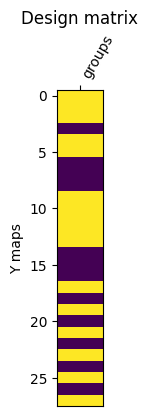
INFO | 15/06/25 16:40:22 | nispace: 1d array provided for design. Assuming this to be dummy-coded groups!
INFO | 15/06/25 16:40:22 | nispace: Design matrix of shape (28, 1). Assuming 28 subjects/maps.
INFO | 15/06/25 16:40:22 | nispace: *** NiSpace.transform_y() - Y transformation and comparison. ***
INFO | 15/06/25 16:40:22 | nispace: Groups/sessions vector provided, ensuring dummy-coding.
INFO | 15/06/25 16:40:22 | nispace: Applying Y transform 'hedges(a,b)'.
INFO | 15/06/25 16:40:22 | nispace: *** NiSpace.colocalize() - Estimating X & Y colocalizations. ***
INFO | 15/06/25 16:40:22 | nispace: Running 'spearman' colocalization with 'hedges(a,b)' transform.
Colocalizing (spearman, -1 proc): 100%|██████████| 1/1 [00:00<00:00, 84.29it/s]
INFO | 15/06/25 16:40:26 | nispace: *** NiSpace.permute() - Estimate exact non-parametric p values. ***
INFO | 15/06/25 16:40:26 | nispace: Permutation of: Y groups.
INFO | 15/06/25 16:40:26 | nispace: Loading transformed Y data, transform = 'hedges(a,b)'.
INFO | 15/06/25 16:40:26 | nispace: Will calculate p values for mean calculation across Y maps. Set 'p_from_average_y_coloc' = False to change this behavior.
INFO | 15/06/25 16:40:26 | nispace: Loading observed colocalizations (method = 'spearman').
INFO | 15/06/25 16:40:26 | nispace: Generating permuted Y groups.
INFO | 15/06/25 16:40:26 | nispace: Permuting groups/sessions vector, strategy: unpaired, proportional.
Permuting groups (-1 proc): 100%|██████████| 10000/10000 [00:00<00:00, 107322.53it/s]
Null transformations (spearman, -1 proc): 100%|██████████| 10000/10000 [00:01<00:00, 8861.95it/s]
Null colocalizations (spearman, -1 proc): 100%|██████████| 10000/10000 [00:01<00:00, 6373.81it/s]
INFO | 15/06/25 16:40:32 | nispace: Calculating exact p-values (tails = {'rho': 'two'}).
INFO | 15/06/25 16:40:32 | nispace: *** NiSpace.correct_p() - Correct p values for multiple comparisons. ***
INFO | 15/06/25 16:40:32 | nispace: *** NiSpace.plot() - Plot colocalization results. ***
INFO | 15/06/25 16:40:33 | nispace: Creating categorical plot for method spearman, colocalization stat rho.
INFO | 15/06/25 16:40:33 | nispace: Returning colocalizations:
| METHOD | XSEA | X_REDUCTION | Y_TRANSFORM |
| spearman | False | False | hedges(a,b) |
INFO | 15/06/25 16:40:33 | nispace: Returning p values:
| METHOD | PERMUTE_WHAT | XSEA | MC_METHOD | NORM | X_REDUCTION | Y_TRANSFORM |
| spearman | groups | False | None | False | False | hedges(a,b) |
INFO | 15/06/25 16:40:33 | nispace: Returning p values:
| METHOD | PERMUTE_WHAT | XSEA | MC_METHOD | NORM | X_REDUCTION | Y_TRANSFORM |
| spearman | groups | False | fdrbh | False | False | hedges(a,b) |
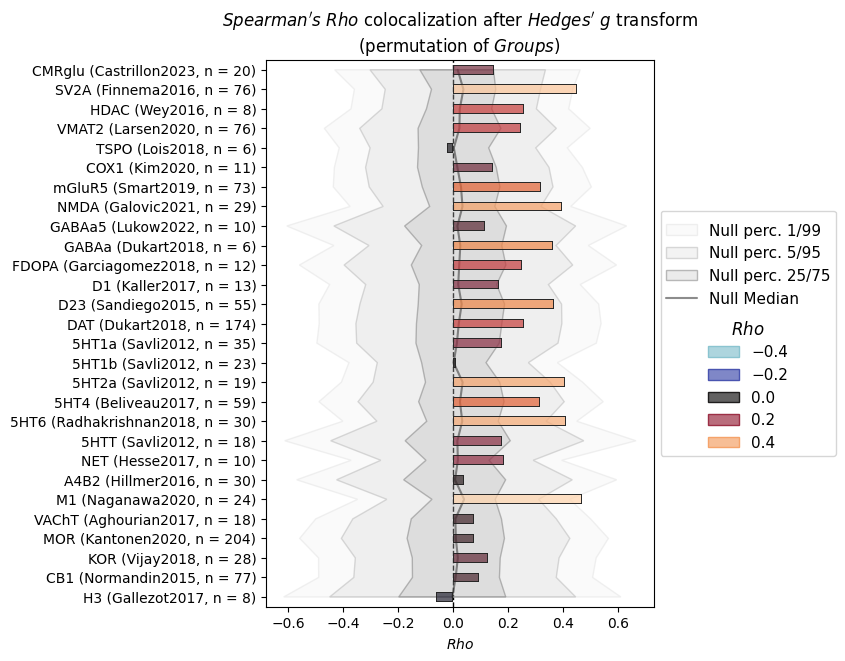
The plot (null distributions in gray) shows that there are some borderline significant results but the effects are not too strong. As said above, we can expect the results to be stronger with the more fine-grained Destrieux parcellation.
Here’s the top 5 results (FDR-corrected) of the Desikan-Killiany results (not significant at FDR=0.05):
[17]:
qvalues.T["mean"].sort_values().head(5)
[17]:
set map
General target-SV2A_tracer-ucbj_n-76_dx-hc_pub-finnema2016 0.22960
Noradrenaline/Acetylcholine target-M1_tracer-lsn3172176_n-24_dx-hc_pub-naganawa2020 0.22960
Glutamate target-NMDA_tracer-ge179_n-29_dx-hc_pub-galovic2021 0.25200
Serotonin target-5HT6_tracer-gsk215083_n-30_dx-hc_pub-radhakrishnan2018 0.25200
target-5HT2a_tracer-altanserin_n-19_dx-hc_pub-savli2012 0.27888
Name: mean, dtype: float32
The outputs of the workflow function are:
colocs: the correlation coefficients between the effect size maps and the reference data across parcelspvalues: the p values for each correlation coefficientqvalues: the FDR-corrected p values for each correlation coefficientnsp_object: the NiSpace object, which contains the results and can be used for further analyses
We will print the first three dataframes:
[18]:
display("Colocalization:", colocs)
display("p values:", pvalues)
display("q values:", qvalues)
'Colocalization:'
| set | General | Immunity | Glutamate | GABA | ... | Serotonin | Noradrenaline/Acetylcholine | Opiods/Endocannabinoids | Histamine | ||||||||||||
|---|---|---|---|---|---|---|---|---|---|---|---|---|---|---|---|---|---|---|---|---|---|
| map | target-CMRglu_tracer-fdg_n-20_dx-hc_pub-castrillon2023 | target-SV2A_tracer-ucbj_n-76_dx-hc_pub-finnema2016 | target-HDAC_tracer-martinostat_n-8_dx-hc_pub-wey2016 | target-VMAT2_tracer-dtbz_n-76_dx-hc_pub-larsen2020 | target-TSPO_tracer-pbr28_n-6_dx-hc_pub-lois2018 | target-COX1_tracer-ps13_n-11_dx-hc_pub-kim2020 | target-mGluR5_tracer-abp688_n-73_dx-hc_pub-smart2019 | target-NMDA_tracer-ge179_n-29_dx-hc_pub-galovic2021 | target-GABAa5_tracer-ro154513_n-10_dx-hc_pub-lukow2022 | target-GABAa_tracer-flumazenil_n-6_dx-hc_pub-dukart2018 | ... | target-5HT6_tracer-gsk215083_n-30_dx-hc_pub-radhakrishnan2018 | target-5HTT_tracer-dasb_n-18_dx-hc_pub-savli2012 | target-NET_tracer-mrb_n-10_dx-hc_pub-hesse2017 | target-A4B2_tracer-flubatine_n-30_dx-hc_pub-hillmer2016 | target-M1_tracer-lsn3172176_n-24_dx-hc_pub-naganawa2020 | target-VAChT_tracer-feobv_n-18_dx-hc_pub-aghourian2017 | target-MOR_tracer-carfentanil_n-204_dx-hc_pub-kantonen2020 | target-KOR_tracer-ly2795050_n-28_dx-hc_pub-vijay2018 | target-CB1_tracer-omar_n-77_dx-hc_pub-normandin2015 | target-H3_tracer-gsk189254_n-8_dx-hc_pub-gallezot2017 |
| hedges | 0.147879 | 0.45021 | 0.257929 | 0.245451 | -0.023862 | 0.145149 | 0.317631 | 0.396057 | 0.113513 | 0.364055 | ... | 0.411043 | 0.17885 | 0.185122 | 0.040447 | 0.468654 | 0.076186 | 0.074304 | 0.126874 | 0.093026 | -0.061343 |
1 rows × 28 columns
'p values:'
| set | General | Immunity | Glutamate | GABA | ... | Serotonin | Noradrenaline/Acetylcholine | Opiods/Endocannabinoids | Histamine | ||||||||||||
|---|---|---|---|---|---|---|---|---|---|---|---|---|---|---|---|---|---|---|---|---|---|
| map | target-CMRglu_tracer-fdg_n-20_dx-hc_pub-castrillon2023 | target-SV2A_tracer-ucbj_n-76_dx-hc_pub-finnema2016 | target-HDAC_tracer-martinostat_n-8_dx-hc_pub-wey2016 | target-VMAT2_tracer-dtbz_n-76_dx-hc_pub-larsen2020 | target-TSPO_tracer-pbr28_n-6_dx-hc_pub-lois2018 | target-COX1_tracer-ps13_n-11_dx-hc_pub-kim2020 | target-mGluR5_tracer-abp688_n-73_dx-hc_pub-smart2019 | target-NMDA_tracer-ge179_n-29_dx-hc_pub-galovic2021 | target-GABAa5_tracer-ro154513_n-10_dx-hc_pub-lukow2022 | target-GABAa_tracer-flumazenil_n-6_dx-hc_pub-dukart2018 | ... | target-5HT6_tracer-gsk215083_n-30_dx-hc_pub-radhakrishnan2018 | target-5HTT_tracer-dasb_n-18_dx-hc_pub-savli2012 | target-NET_tracer-mrb_n-10_dx-hc_pub-hesse2017 | target-A4B2_tracer-flubatine_n-30_dx-hc_pub-hillmer2016 | target-M1_tracer-lsn3172176_n-24_dx-hc_pub-naganawa2020 | target-VAChT_tracer-feobv_n-18_dx-hc_pub-aghourian2017 | target-MOR_tracer-carfentanil_n-204_dx-hc_pub-kantonen2020 | target-KOR_tracer-ly2795050_n-28_dx-hc_pub-vijay2018 | target-CB1_tracer-omar_n-77_dx-hc_pub-normandin2015 | target-H3_tracer-gsk189254_n-8_dx-hc_pub-gallezot2017 |
| mean | 0.496 | 0.0164 | 0.1684 | 0.3216 | 0.897 | 0.5398 | 0.1592 | 0.0346 | 0.7084 | 0.1138 | ... | 0.036 | 0.5642 | 0.3138 | 0.902 | 0.0082 | 0.7904 | 0.812 | 0.6318 | 0.7252 | 0.8368 |
1 rows × 28 columns
'q values:'
| set | General | Immunity | Glutamate | GABA | ... | Serotonin | Noradrenaline/Acetylcholine | Opiods/Endocannabinoids | Histamine | ||||||||||||
|---|---|---|---|---|---|---|---|---|---|---|---|---|---|---|---|---|---|---|---|---|---|
| map | target-CMRglu_tracer-fdg_n-20_dx-hc_pub-castrillon2023 | target-SV2A_tracer-ucbj_n-76_dx-hc_pub-finnema2016 | target-HDAC_tracer-martinostat_n-8_dx-hc_pub-wey2016 | target-VMAT2_tracer-dtbz_n-76_dx-hc_pub-larsen2020 | target-TSPO_tracer-pbr28_n-6_dx-hc_pub-lois2018 | target-COX1_tracer-ps13_n-11_dx-hc_pub-kim2020 | target-mGluR5_tracer-abp688_n-73_dx-hc_pub-smart2019 | target-NMDA_tracer-ge179_n-29_dx-hc_pub-galovic2021 | target-GABAa5_tracer-ro154513_n-10_dx-hc_pub-lukow2022 | target-GABAa_tracer-flumazenil_n-6_dx-hc_pub-dukart2018 | ... | target-5HT6_tracer-gsk215083_n-30_dx-hc_pub-radhakrishnan2018 | target-5HTT_tracer-dasb_n-18_dx-hc_pub-savli2012 | target-NET_tracer-mrb_n-10_dx-hc_pub-hesse2017 | target-A4B2_tracer-flubatine_n-30_dx-hc_pub-hillmer2016 | target-M1_tracer-lsn3172176_n-24_dx-hc_pub-naganawa2020 | target-VAChT_tracer-feobv_n-18_dx-hc_pub-aghourian2017 | target-MOR_tracer-carfentanil_n-204_dx-hc_pub-kantonen2020 | target-KOR_tracer-ly2795050_n-28_dx-hc_pub-vijay2018 | target-CB1_tracer-omar_n-77_dx-hc_pub-normandin2015 | target-H3_tracer-gsk189254_n-8_dx-hc_pub-gallezot2017 |
| mean | 0.816941 | 0.2296 | 0.523911 | 0.692677 | 0.935407 | 0.831453 | 0.523911 | 0.252 | 0.922982 | 0.523911 | ... | 0.252 | 0.831453 | 0.692677 | 0.935407 | 0.2296 | 0.935407 | 0.935407 | 0.88452 | 0.922982 | 0.935407 |
1 rows × 28 columns
Simple group comparison using the Destrieux parcellation#
Let’s see how the results look like with the more fine-grained Destrieux parcellation.
[19]:
# rerun with Destrieux parcellation, suppress output and design matrix plotting
colocs_es, pvalues_es, qvalues_es, nsp_object_es = group_comparison(
y=df_destrieux, # sample data
x=df_reference_destrieux, # reference data
parcellation="Destrieux", # parcellation
design=design, # group membership or "design matrix"
comparison_method="hedges(a,b)", # effect size difference
colocalization_method="spearman", # spearman correlation betw. each x and y
n_perm=10000, # number of permutations for exact p values
n_proc=-1, # number of cores to use (-1 = all available)
verbose=False,
plot_design=False,
)
INFO | 15/06/25 16:40:33 | nispace: Loading cortex parcellation 'Destrieux' in 'MNI152NLin2009cAsym' space.
INFO | 15/06/25 16:40:33 | nispace: Loaded integrated parcellation with pre-calculated distance matrix.
INFO | 15/06/25 16:40:33 | nispace: Checking input data for 'x' (should be, e.g., PET data):
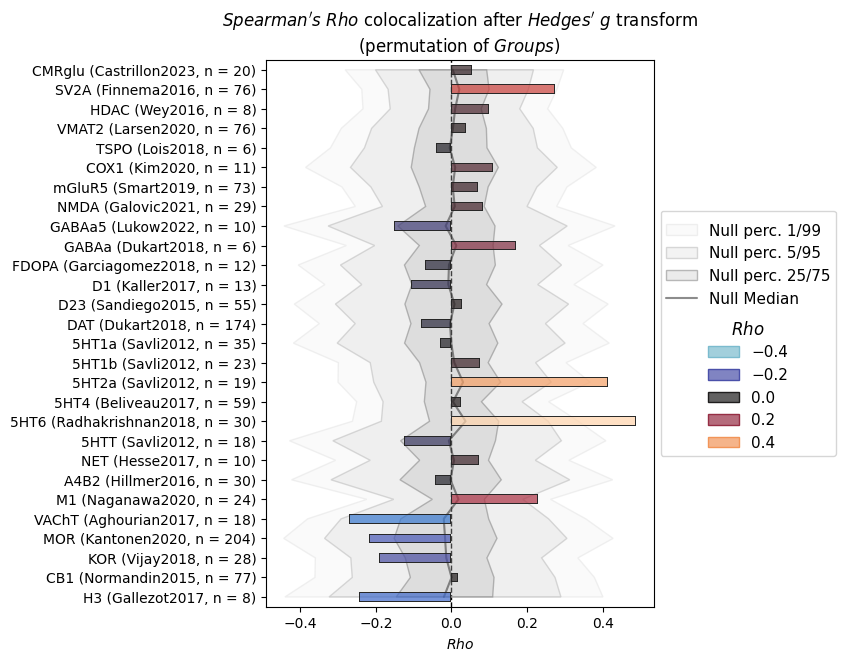
There we go! The results pattern is expectedly similar, but with stronger effects and higher specificity. We find clear positive correlations between cortical thickness alteration patterns in fragile X syndrome and 5HT2a, 5HT6, GABAa and M1 receptors, as well as synaptic density (SV2A) and transcriptomic activity (HDAC).
The positive correlation here means that areas with increased cortical thickness in fragile X syndrome versus controls are those with the highest density of the mentioned molecules in “healthy” brains.
Let’s take a short look at the FDR-corrected p values across the two parcellations:
[20]:
pvalues_es.T["mean"].sort_values().head(6)
[20]:
set map
Serotonin target-5HT6_tracer-gsk215083_n-30_dx-hc_pub-radhakrishnan2018 0.0001
target-5HT2a_tracer-altanserin_n-19_dx-hc_pub-savli2012 0.0048
General target-SV2A_tracer-ucbj_n-76_dx-hc_pub-finnema2016 0.0224
Noradrenaline/Acetylcholine target-M1_tracer-lsn3172176_n-24_dx-hc_pub-naganawa2020 0.0472
target-VAChT_tracer-feobv_n-18_dx-hc_pub-aghourian2017 0.1286
Histamine target-H3_tracer-gsk189254_n-8_dx-hc_pub-gallezot2017 0.2382
Name: mean, dtype: float32
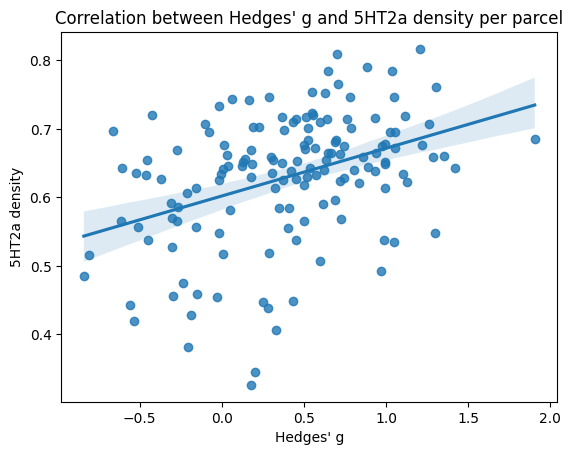
And this would be what the correlation itself looks like for a single reference map:
[21]:
import matplotlib.pyplot as plt
from seaborn import regplot
regplot(
x=nsp_object_es.get_y(Y_transform="hedges(a,b)").loc["hedges"],
y=df_reference_destrieux.loc[("Serotonin", "target-5HT2a_tracer-altanserin_n-19_dx-hc_pub-savli2012")],
)
plt.xlabel("Hedges' g")
plt.ylabel("5HT2a density")
plt.title("Correlation between Hedges' g and 5HT2a density per parcel")
[21]:
Text(0.5, 1.0, "Correlation between Hedges' g and 5HT2a density per parcel")
Advanced analyses: Group comparison using single-subject zscores#
This is the standard workflow introduced with the JuSpace toolbox. The difference to above is that we do not calculate a single group-level effect size map, but instead we will calculate a z-score map for each subject as in ( case_subject - mean(control_subjects) ) / sd(control_subjects). The automatically generated plots will show individual-level values as dots instead of the bars seen above.
The results should be similar, but we will have single-subject correlation coefficients, which is quite useful for follow-up analyses. I.e., we could check whether the individual alignment with a given PET map is associated with a clinical variable of interest. This analysis will take a bit longer in larger samples because of more necessary computations.
[22]:
colocs_zscore, pvalues_zscore, qvalues_zscore, nsp_object_zscore = group_comparison(
y=df_destrieux, # sample data
x=df_reference_destrieux, # reference data
parcellation="Destrieux", # parcellation
design=design, # group membership
comparison_method="zscore(a,b)",
colocalization_method="spearman", # spearman correlation betw. each x and y
n_perm=10000, # number of permutations for exact p values
n_proc=-1, # number of cores to use (-1 = all available)
verbose=False,
plot_design=False,
)
INFO | 15/06/25 16:40:37 | nispace: Loading cortex parcellation 'Destrieux' in 'MNI152NLin2009cAsym' space.
INFO | 15/06/25 16:40:37 | nispace: Loaded integrated parcellation with pre-calculated distance matrix.
INFO | 15/06/25 16:40:37 | nispace: Checking input data for 'x' (should be, e.g., PET data):
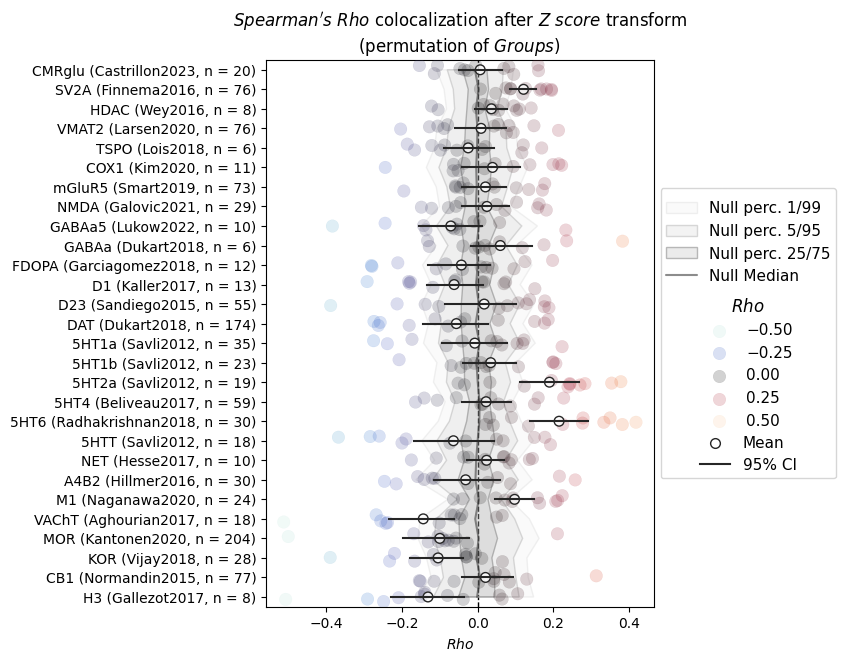
As we now have single-subject correlation coefficients for all FrX subjects, the resulting colocalization dataframe will have one row for each subject. P values, however, are by default calculated for the mean of the sample, so they will still have one row across all subjects.
[23]:
display("Colocalization:", colocs_zscore.head(3))
display("P values:", pvalues_zscore)
'Colocalization:'
| set | General | Immunity | Glutamate | GABA | ... | Serotonin | Noradrenaline/Acetylcholine | Opiods/Endocannabinoids | Histamine | ||||||||||||
|---|---|---|---|---|---|---|---|---|---|---|---|---|---|---|---|---|---|---|---|---|---|
| map | target-CMRglu_tracer-fdg_n-20_dx-hc_pub-castrillon2023 | target-SV2A_tracer-ucbj_n-76_dx-hc_pub-finnema2016 | target-HDAC_tracer-martinostat_n-8_dx-hc_pub-wey2016 | target-VMAT2_tracer-dtbz_n-76_dx-hc_pub-larsen2020 | target-TSPO_tracer-pbr28_n-6_dx-hc_pub-lois2018 | target-COX1_tracer-ps13_n-11_dx-hc_pub-kim2020 | target-mGluR5_tracer-abp688_n-73_dx-hc_pub-smart2019 | target-NMDA_tracer-ge179_n-29_dx-hc_pub-galovic2021 | target-GABAa5_tracer-ro154513_n-10_dx-hc_pub-lukow2022 | target-GABAa_tracer-flumazenil_n-6_dx-hc_pub-dukart2018 | ... | target-5HT6_tracer-gsk215083_n-30_dx-hc_pub-radhakrishnan2018 | target-5HTT_tracer-dasb_n-18_dx-hc_pub-savli2012 | target-NET_tracer-mrb_n-10_dx-hc_pub-hesse2017 | target-A4B2_tracer-flubatine_n-30_dx-hc_pub-hillmer2016 | target-M1_tracer-lsn3172176_n-24_dx-hc_pub-naganawa2020 | target-VAChT_tracer-feobv_n-18_dx-hc_pub-aghourian2017 | target-MOR_tracer-carfentanil_n-204_dx-hc_pub-kantonen2020 | target-KOR_tracer-ly2795050_n-28_dx-hc_pub-vijay2018 | target-CB1_tracer-omar_n-77_dx-hc_pub-normandin2015 | target-H3_tracer-gsk189254_n-8_dx-hc_pub-gallezot2017 |
| sub-HM06 | -0.153929 | 0.007294 | -0.104420 | 0.076167 | 0.020851 | -0.035747 | -0.046130 | -0.057443 | 0.058151 | -0.127871 | ... | 0.020743 | 0.149822 | 0.089360 | -0.246324 | -0.040208 | -0.061688 | -0.104471 | -0.232777 | 0.083851 | -0.140744 |
| sub-HM09 | 0.161004 | 0.168028 | 0.066939 | 0.043035 | -0.121139 | 0.018174 | 0.135101 | 0.102845 | -0.136747 | 0.032122 | ... | 0.031551 | -0.199951 | -0.036917 | 0.257904 | 0.071968 | 0.049628 | -0.092817 | -0.030405 | -0.151537 | 0.105929 |
| sub-HM10 | 0.159378 | 0.126809 | 0.103099 | -0.203596 | -0.166683 | 0.046041 | 0.039254 | -0.121843 | -0.244572 | -0.132404 | ... | 0.041281 | -0.367951 | 0.020064 | 0.216137 | -0.063887 | -0.069980 | -0.026912 | -0.029424 | -0.115149 | 0.057532 |
3 rows × 28 columns
'P values:'
| set | General | Immunity | Glutamate | GABA | ... | Serotonin | Noradrenaline/Acetylcholine | Opiods/Endocannabinoids | Histamine | ||||||||||||
|---|---|---|---|---|---|---|---|---|---|---|---|---|---|---|---|---|---|---|---|---|---|
| map | target-CMRglu_tracer-fdg_n-20_dx-hc_pub-castrillon2023 | target-SV2A_tracer-ucbj_n-76_dx-hc_pub-finnema2016 | target-HDAC_tracer-martinostat_n-8_dx-hc_pub-wey2016 | target-VMAT2_tracer-dtbz_n-76_dx-hc_pub-larsen2020 | target-TSPO_tracer-pbr28_n-6_dx-hc_pub-lois2018 | target-COX1_tracer-ps13_n-11_dx-hc_pub-kim2020 | target-mGluR5_tracer-abp688_n-73_dx-hc_pub-smart2019 | target-NMDA_tracer-ge179_n-29_dx-hc_pub-galovic2021 | target-GABAa5_tracer-ro154513_n-10_dx-hc_pub-lukow2022 | target-GABAa_tracer-flumazenil_n-6_dx-hc_pub-dukart2018 | ... | target-5HT6_tracer-gsk215083_n-30_dx-hc_pub-radhakrishnan2018 | target-5HTT_tracer-dasb_n-18_dx-hc_pub-savli2012 | target-NET_tracer-mrb_n-10_dx-hc_pub-hesse2017 | target-A4B2_tracer-flubatine_n-30_dx-hc_pub-hillmer2016 | target-M1_tracer-lsn3172176_n-24_dx-hc_pub-naganawa2020 | target-VAChT_tracer-feobv_n-18_dx-hc_pub-aghourian2017 | target-MOR_tracer-carfentanil_n-204_dx-hc_pub-kantonen2020 | target-KOR_tracer-ly2795050_n-28_dx-hc_pub-vijay2018 | target-CB1_tracer-omar_n-77_dx-hc_pub-normandin2015 | target-H3_tracer-gsk189254_n-8_dx-hc_pub-gallezot2017 |
| mean | 0.7696 | 0.0008 | 0.2396 | 0.845 | 0.6316 | 0.4728 | 0.6528 | 0.4926 | 0.2874 | 0.1896 | ... | 0.0001 | 0.3292 | 0.5584 | 0.713 | 0.0072 | 0.03 | 0.1538 | 0.0816 | 0.7972 | 0.0594 |
1 rows × 28 columns
Post-hoc analyses#
As mentioned above, if using the “zscore” group comparison method, we can perform post-hoc analyses on the single-subject correlation coefficients. This just serves to demonstrate how to work with the colocalization results.
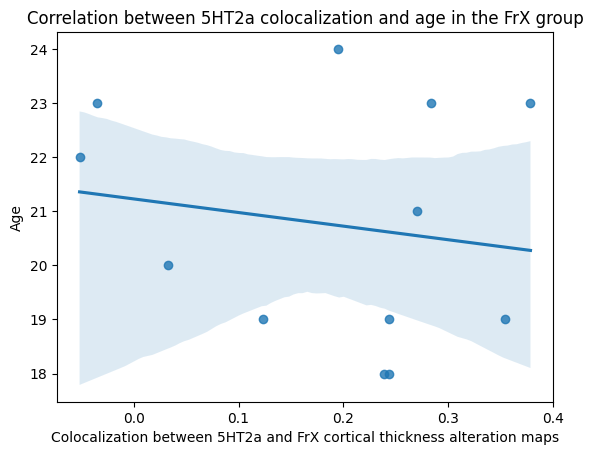
In our small sample, we will not find much interesting.
[24]:
# colocalizations for 5HT2a
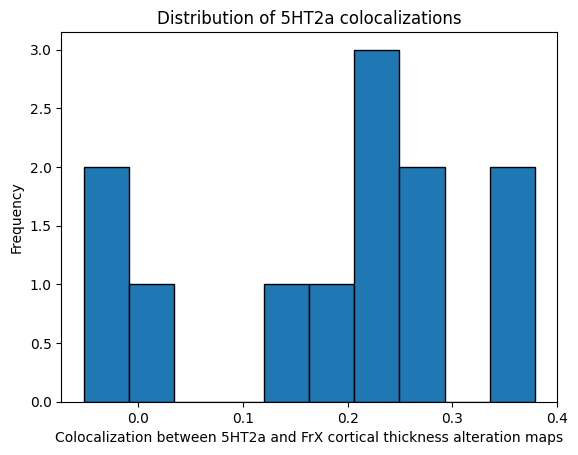
colocs_5HT2a = colocs_zscore.loc[:, ("Serotonin", "target-5HT2a_tracer-altanserin_n-19_dx-hc_pub-savli2012")]
# show the distributions of these values
colocs_5HT2a.plot.hist(legend=False, title="Distribution of 5HT2a colocalizations", edgecolor="k")
plt.xlabel("Colocalization between 5HT2a and FrX cortical thickness alteration maps")
plt.show()
# Example:
regplot(
x=colocs_5HT2a,
y=df_participants.age[df_participants.diagnosis == "FrX"],
)
plt.ylabel("Age")
plt.xlabel("Colocalization between 5HT2a and FrX cortical thickness alteration maps")
_ = plt.title("Correlation between 5HT2a colocalization and age in the FrX group")
Add-on: Gene-set enrichment#
We found that cortical thickness alterations in fragile X syndrome are spatially associated with serotonergic and GABAergic receptor distributions, which are two of the major cortical transmitter systems. Furthermore, we observed associations to transmitter system-overarching components (synaptic density, transcriptomic activity).
We could now ask if we can further specify this, possibly system-unspecific, association. Instead of the PET data, we can also use transcriptomic data as a reference. These have the major disadvantage of being very indirect and postmortem measurements, however, we here gain the possibility of checking spatial associations to transcriptomic distributions of many individual genes or sets of genes.
NiSpace currently includes two transcriptomic datasets: They both were build from the Allen Human Brain Atlas (AHBA), the first (“mrna”) using the abagen toolbox, the second (“magicc”) using the data provided by Wagstyl et al., 2024 (https://doi.org/10.7554/eLife.86933.1). We will go with the magicc dataset for now.
Neuroimaging gene-set enrichment analysis checks if a set of genes (e.g. 20 genes associated with vesicle trafficking) correlate more strongly with an outcome of interest (e.g., our FrX effect size map) than expected by chance. Our gene sets will be defined by the SynGO dataset, which consists of gene sets sorted by their implications in specific synaptic functions.
Get effect size map from another analysis#
We will perform our analysis on a parcel-wise hedge’s g effect size map from the very first analysis.
[25]:
# get FrX vs HC effect size map from another analysis (no colocalization performed yet)
effect_sizes = nsp_object_es.get_y(Y_transform="hedges(a,b)")
# show effect size map (left hemisphere: first 74 parcels)
view_surf(effect_sizes.iloc[:, :74], parcellation="Destrieux", template="fsaverage", hemi="L")
INFO | 15/06/25 16:40:48 | nispace: Loading cortex parcellation 'Destrieux' in 'fsaverage' space.
[25]:
Run the analysis#
We will run the X-set enrichment analysis (XSEA) workflow function. Called like below, it will automatically fetch the “magicc” reference data (as opposed to above, where we called the PET data independently before). The SynGO dataset is defined via the “x_collection” parameter and the special “set_size_range” parameter is used to only include gene sets with a size between 10 and inf genes (to exclude sets with only 1-9 genes).
[26]:
from nispace.workflows import simple_xsea
# perform gene-set enrichment analysis
colocs_xsea, pvalues_xsea, qvalues_xsea, nsp_xsea = simple_xsea(
y=effect_sizes,
x="magicc",
x_collection="SynGO",
fetch_x_kwargs={"set_size_range": (10, None)},
parcellation="Destrieux",
colocalization_method="pls",
permute_sets=True,
n_perm=10000,
n_proc=-1,
verbose=True,
plot=False
)
INFO | 15/06/25 16:40:48 | nispace: Trying to fetch background X dataset.
INFO | 15/06/25 16:40:48 | nispace: Loading magicc maps.
INFO | 15/06/25 16:40:48 | nispace: Loading data parcellated with 'Destrieux'
INFO | 15/06/25 16:40:48 | nispace: Using integrated parcellation Destrieux.
INFO | 15/06/25 16:40:48 | nispace: Loading integrated magicc dataset as X data.
INFO | 15/06/25 16:40:48 | nispace: Loading magicc maps.
INFO | 15/06/25 16:40:48 | nispace: Applying collection filter from: /Users/llotter/nispace-data/reference/magicc/collection-SynGO.collect.
INFO | 15/06/25 16:40:56 | nispace: Filtering to collection sets with between 10 and inf maps.
INFO | 15/06/25 16:41:00 | nispace: Loading data parcellated with 'Destrieux'
The NiSpace "magicc" dataset is based on Allen Human Brain Atlas (AHBA) gene expression data published in Hawrylycz et al.,
2012 (https://doi.org/10.1038/nature11405). The dataset consists of mRNA expression data from postmortem brain tissue of
six donors, mapped onto continuous fsLR space as described in Wagstyl et al., 2024 (https://doi.org/10.7554/eLife.86933.1),
and parcellated with integrated parcellation. Only genes that showed a high reproducibility (>= 0.5, see paper) were retained.
In addition to the two publications listed above, please cite publications associated with gene set collections as appropriate.
To ensure reproducibility, note the NiSpace commit/version: 2cb3a7f5c1cea6417fe7613465a1c503f77c87c6
- SynGO Source: Koopmans2019 https://doi.org/10.1016/j.neuron.2019.05.002
INFO | 15/06/25 16:41:00 | nispace: *** NiSpace.fit() - Data extraction and preparation. ***
INFO | 15/06/25 16:41:00 | nispace: Loading cortex parcellation 'Destrieux' in 'MNI152NLin2009cAsym' space.
INFO | 15/06/25 16:41:00 | nispace: Loaded integrated parcellation with pre-calculated distance matrix.
INFO | 15/06/25 16:41:00 | nispace: Checking input data for 'x' (should be, e.g., PET data):
INFO | 15/06/25 16:41:00 | nispace: Input type: DataFrame, assuming parcellated data with shape (n_files/subjects/etc, n_parcels).
INFO | 15/06/25 16:41:00 | nispace: Got 'x' data for 9030 x 148 parcels.
INFO | 15/06/25 16:41:00 | nispace: Checking input data for 'y' (should be, e.g., subject data):
INFO | 15/06/25 16:41:00 | nispace: Input type: DataFrame, assuming parcellated data with shape (n_files/subjects/etc, n_parcels).
INFO | 15/06/25 16:41:00 | nispace: Got 'y' data for 1 x 148 parcels.
INFO | 15/06/25 16:41:00 | nispace: Z-standardizing 'X' data.
INFO | 15/06/25 16:41:00 | nispace: *** NiSpace.colocalize() - Estimating X & Y colocalizations. ***
INFO | 15/06/25 16:41:00 | nispace: Running 'pls' colocalization.
INFO | 15/06/25 16:41:00 | nispace: Will perform X-set enrichment analysis (XSEA).
INFO | 15/06/25 16:41:00 | nispace: Using 119 sets with between 10 and 1178 samples. Aggregating within-set colocalizations with: mean.
Colocalizing (pls, -1 proc): 100%|██████████| 1/1 [00:00<00:00, 837.52it/s]
INFO | 15/06/25 16:41:00 | nispace: *** NiSpace.permute() - Estimate exact non-parametric p values. ***
INFO | 15/06/25 16:41:00 | nispace: Permutation of: X sets.
INFO | 15/06/25 16:41:00 | nispace: Loading observed colocalizations (method = 'pls').
INFO | 15/06/25 16:41:00 | nispace: Generating permuted X sets.
INFO | 15/06/25 16:41:00 | nispace: Will use 11146 provided background maps.
INFO | 15/06/25 16:41:00 | nispace: Z-standardizing X background maps.
Permuting X set indices: 100%|██████████| 10000/10000 [00:06<00:00, 1502.77it/s]
Null colocalizations (pls, -1 proc): 100%|██████████| 10000/10000 [03:10<00:00, 52.56it/s]
INFO | 15/06/25 16:44:17 | nispace: Calculating exact p-values (tails = {'r2': 'upper', 'beta': 'two'}).
INFO | 15/06/25 16:44:18 | nispace: *** NiSpace.correct_p() - Correct p values for multiple comparisons. ***
INFO | 15/06/25 16:44:18 | nispace: Returning colocalizations:
| METHOD | XSEA | X_REDUCTION | Y_TRANSFORM |
| pls | True | False | False |
INFO | 15/06/25 16:44:18 | nispace: Returning p values:
| METHOD | PERMUTE_WHAT | XSEA | MC_METHOD | NORM | X_REDUCTION | Y_TRANSFORM |
| pls | sets | True | None | False | False | False |
INFO | 15/06/25 16:44:18 | nispace: Returning p values:
| METHOD | PERMUTE_WHAT | XSEA | MC_METHOD | NORM | X_REDUCTION | Y_TRANSFORM |
| pls | sets | True | fdrbh | False | False | False |
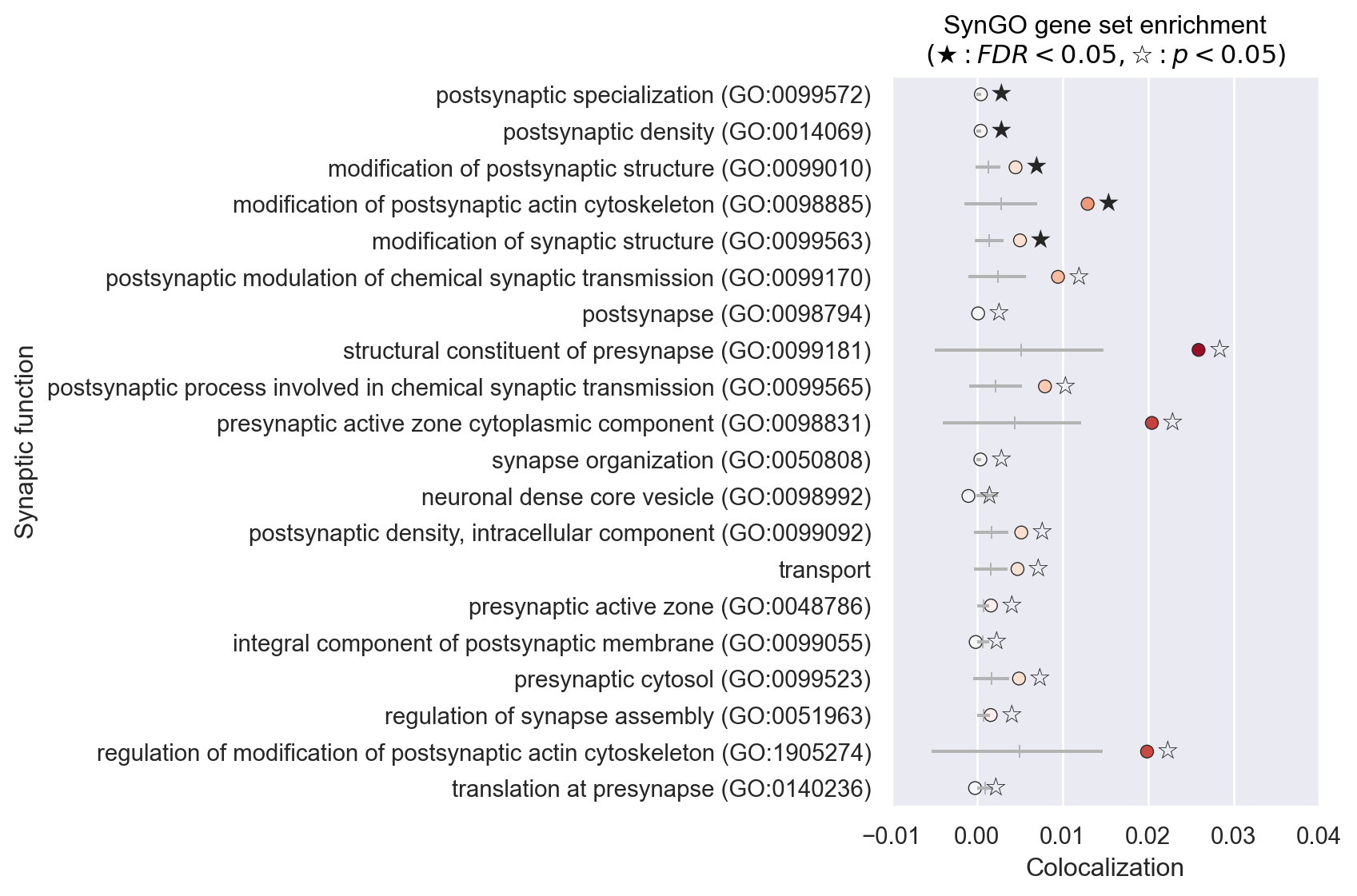
We take a look at the FDR-corrected results: We find some significant results and can generally confirm our result on the spatial association to synaptic density at the postsynapse and possibly synaptic structure.
We might therefore preliminarily conclude that we deal with a rather fundamental structural synaptic dysfunction in fragile X syndrome, rather than with a dysfunction of a specific transmitter system.
[27]:
# the chosen method, PLS, will return results as dicts with two data frames: beta and r2
# we look at beta
qvalues_xsea["beta"].loc["hedges"].sort_values().head(10)
[27]:
postsynaptic specialization (GO:0099572) 0.007933
postsynaptic density (GO:0014069) 0.007933
modification of postsynaptic structure (GO:0099010) 0.007933
modification of postsynaptic actin cytoskeleton (GO:0098885) 0.035700
modification of synaptic structure (GO:0099563) 0.038080
postsynaptic modulation of chemical synaptic transmission (GO:0099170) 0.067433
postsynapse (GO:0098794) 0.068000
structural constituent of presynapse (GO:0099181) 0.068425
postsynaptic process involved in chemical synaptic transmission (GO:0099565) 0.077891
synapse organization (GO:0050808) 0.077891
Name: hedges, dtype: float32
Plot the results#
We now plot all results that are uncorrected significant for an overview. We could do that, as we did automatically in the workflow function above, by calling .plot() on the nispace object. However, as this will produce a very big plot with many categories, we will do it manually here, and only for FDR-corrected results. The function to produce adequate plots for this kind of data is currently not implemented in NiSpace.
[28]:
import seaborn.objects as so
# create a dataframe with the null distribution
plot_data_null = (
pd.concat(nsp_xsea.get_colocalizations(get_nulls=True, stats="beta", nulls_permute_what="sets")[1])
.droplevel(1)
)
display(plot_data_null.head(3))
# create a dataframe with the results
plot_data = pd.DataFrame(
{
"set": colocs_xsea["beta"].columns,
"coloc": colocs_xsea["beta"].loc["hedges"],
"p": pvalues_xsea["beta"].loc["hedges"],
"q": qvalues_xsea["beta"].loc["hedges"],
"null_median": plot_data_null.median(axis=1),
"null_pi10": plot_data_null.quantile(0.1, axis=1),
"null_pi90": plot_data_null.quantile(0.9, axis=1),
}
)
plot_data = plot_data.query("p < 0.05").sort_values("q")
display(plot_data.head(3))
# plot
(
so.Plot(
plot_data, # subset data to only include uncorrected significant results
x="coloc",
y="set",
color="coloc",
text=["$★$" if q < 0.05 else "$☆$" if p < 0.05 else "" for q, p in zip(plot_data.q, plot_data.p)],
)
.add(so.Range(color="0.7"), xmin="null_pi10", xmax="null_pi90", legend=False)
.add(so.Dot(marker="|", color="0.7"), x="null_median", legend=False)
.add(so.Dot(edgecolor="k"), legend=False)
.add(so.Text(color="k", valign="center", halign="left", offset=4))
.scale(color=so.Continuous("RdBu_r", norm=(-0.03, 0.03)))
.limit(x=(-0.01, 0.04))
.label(x="Colocalization", y="Synaptic function", title="SynGO gene set enrichment\n$(★: FDR < 0.05, ☆: p < 0.05)$")
.layout(size=(9, 6))
.plot()
)
INFO | 15/06/25 16:44:22 | nispace: Returning colocalizations:
| METHOD | XSEA | X_REDUCTION | Y_TRANSFORM |
| pls | True | False | False |
| 0 | 1 | 2 | 3 | 4 | 5 | 6 | 7 | 8 | 9 | ... | 9990 | 9991 | 9992 | 9993 | 9994 | 9995 | 9996 | 9997 | 9998 | 9999 | |
|---|---|---|---|---|---|---|---|---|---|---|---|---|---|---|---|---|---|---|---|---|---|
| synapse (GO:0045202) | 0.000069 | 0.000057 | 0.000056 | 0.000075 | 0.000061 | 0.000056 | 0.000065 | 0.000052 | 0.000051 | 0.000049 | ... | 0.000057 | 0.000054 | 0.000056 | 0.000053 | 0.000062 | 0.000053 | 0.000051 | 0.000039 | 0.000048 | 0.000066 |
| synaptic membrane (GO:0097060) | 0.001373 | 0.003137 | 0.005443 | 0.002388 | 0.004345 | 0.003215 | -0.002482 | 0.003836 | 0.001134 | -0.003315 | ... | 0.004754 | 0.000042 | 0.002674 | 0.002272 | 0.003590 | 0.007391 | 0.004566 | 0.003540 | 0.004273 | 0.000693 |
| integral component of synaptic membrane (GO:0099699) | 0.001572 | 0.003478 | 0.002361 | 0.008681 | -0.000088 | 0.009003 | 0.005905 | 0.017981 | 0.004984 | 0.010426 | ... | 0.011871 | 0.005010 | 0.001870 | 0.013045 | 0.003327 | 0.009240 | -0.001340 | 0.014197 | 0.004886 | 0.006027 |
3 rows × 10000 columns
| set | coloc | p | q | null_median | null_pi10 | null_pi90 | |
|---|---|---|---|---|---|---|---|
| postsynaptic specialization (GO:0099572) | postsynaptic specialization (GO:0099572) | 0.000446 | 0.0002 | 0.007933 | 0.000216 | 0.000135 | 0.000299 |
| postsynaptic density (GO:0014069) | postsynaptic density (GO:0014069) | 0.000422 | 0.0001 | 0.007933 | 0.000186 | 0.000120 | 0.000250 |
| modification of postsynaptic structure (GO:0099010) | modification of postsynaptic structure (GO:009... | 0.004506 | 0.0002 | 0.007933 | 0.001295 | 0.000012 | 0.002526 |
[28]:
[ ]: