Advanced topics
This notebook covers advanced features of NiSpace:
reduce_x()) — summarize a large set of reference maps into a smaller number of components before colocalization.We use the ENIGMA reference datasets (enigmathick and enigmaarea) as our input maps here — these contain published cortical thickness and surface area effect sizes (Cohen’s d) for many psychiatric disorders vs. healthy controls. Note that we’re using reference data as our input maps, which, in the case of ENIGMA maps, is however often done: it lets us ask questions like “which reference systems explain patterns of grey matter alterations across psychiatric disorders?”
[2]:
import tqdm.notebook
tqdm.notebook.tqdm = tqdm.tqdm

import numpy as np
import pandas as pd
[3]:
from nispace.datasets import fetch_reference, fetch_example
from nispace.api import NiSpace

# ENIGMA cortical thickness effect sizes (Cohen's d, cases vs. controls)
# These are reference datasets — we use them as target maps (Y) here
enigma_thick = fetch_reference("enigmathick", parcellation="DesikanKilliany", collection="Main",
                               print_references=False)
print(f"ENIGMA thickness: {enigma_thick.shape[0]} disorders x {enigma_thick.shape[1]} cortical parcels")
print("Disorders:", list(enigma_thick.index))

# Continuous resting-state network (RSN) reference maps for colocalization: dataset rsn17
rsn17_maps = fetch_reference("rsn17", parcellation="DesikanKilliany",
                             print_references=False)
print(f"RSN (Kong 17 networks): {rsn17_maps.shape[0]} maps x {rsn17_maps.shape[1]} parcels")
INFO | 20/07/26 18:25:53 | nispace.datasets: Loading enigmathick maps.
INFO | 20/07/26 18:25:53 | nispace.datasets: Loading integrated collection 'Main' for dataset 'enigmathick'.
INFO | 20/07/26 18:25:53 | nispace.datasets: Filtering maps by collection.
INFO | 20/07/26 18:25:53 | nispace.datasets: Loading data parcellated with 'DesikanKilliany'
ENIGMA thickness: 16 disorders x 68 cortical parcels
Disorders: [('dx-mdd_age-adult_pub-schmaal2017',), ('dx-adhd_age-allages_pub-hoogman2019',), ('dx-asd_pub-vanrooij2018',), ('dx-bd_age-adult_pub-hibar2018',), ('dx-scz_pub-vanerp2018',), ('dx-ocd_age-adult_pub-boedhoe2018',), ('dx-epilepsy_pub-whelan2018',), ('dx-epilepsy_subtype-gge_pub-whelan2018',), ('dx-epilepsy_subtype-ltle_pub-whelan2018',), ('dx-epilepsy_subtype-rtle_pub-whelan2018',), ('dx-22q_pub-sun2020',), ('dx-an_pub-walton2022',), ('dx-an_subtype-acAN_pub-walton2022',), ('dx-an_subtype-pwrAN_pub-walton2022',), ('dx-antisocial_pub-gao2024',), ('dx-pd_pub-laansma2021',)]
INFO | 20/07/26 18:25:53 | nispace.datasets: Loading rsn17 maps.
INFO | 20/07/26 18:25:53 | nispace.datasets: Loading data parcellated with 'DesikanKilliany'
RSN (Kong 17 networks): 17 maps x 68 parcels
Individual-level colocalization
The ENIGMA dataset gives us effect size maps for multiple disorders simultaneously. We can test all disorders at once by passing the full DataFrame as y.
[4]:
nsp = NiSpace(
    x=rsn17_maps,
    y=enigma_thick,   # all 22 disorder maps as input
    parcellation="DesikanKilliany",
    seed=42,
    n_proc=4
)
nsp.fit()
nsp.colocalize("spearman")
nsp.permute("maps", n_perm=1000)
nsp.correct_p()

colocs = nsp.get_colocalizations()
print(f"Result: {colocs.shape[0]} disorders x {colocs.shape[1]} receptors")
p_values = nsp.get_p_values()
print(f"Result: {p_values.shape[0]} x {p_values.shape[1]} receptors")
INFO | 20/07/26 18:25:53 | nispace.api: *** NiSpace.fit() - Data extraction and preparation. ***
INFO | 20/07/26 18:25:53 | nispace.core.parcellation: Building cortex Parcellation for 'DesikanKilliany' from library. DOI: 10.1016/j.neuroimage.2006.01.021
INFO | 20/07/26 18:25:53 | nispace.core.parcellation: Available spaces: MNI152NLin2009cAsym, MNI152NLin6Asym, fsLR, fsaverage
INFO | 20/07/26 18:25:53 | nispace.core.parcellation: Parcellation 'DesikanKilliany': validation passed.
INFO | 20/07/26 18:25:53 | nispace.api: Checking input data for 'x' (should be, e.g., PET data):
INFO | 20/07/26 18:25:53 | nispace.io: Input type: DataFrame, assuming parcellated data with shape (n_files/subjects/etc, n_parcels).
INFO | 20/07/26 18:25:53 | nispace.api: Got 'x' data for 17 x 68 parcels.
INFO | 20/07/26 18:25:53 | nispace.api: Checking input data for 'y' (should be, e.g., subject data):
INFO | 20/07/26 18:25:53 | nispace.io: Input type: DataFrame, assuming parcellated data with shape (n_files/subjects/etc, n_parcels).
WARNING | 20/07/26 18:25:53 | nispace.io: Parcellated data contains nan values!
INFO | 20/07/26 18:25:53 | nispace.api: Got 'y' data for 16 x 68 parcels.
INFO | 20/07/26 18:25:53 | nispace.api: Z-standardizing 'X' data.
INFO | 20/07/26 18:25:53 | nispace.api: *** NiSpace.colocalize() - Estimating X & Y colocalizations. ***
INFO | 20/07/26 18:25:53 | nispace.api: Running 'spearman' colocalization.
INFO | 20/07/26 18:25:53 | nispace.api: Pre-ranking X and Y data.
Colocalizing (spearman, 4 proc): 100%|██████████████████████████████████████████████████| 16/16 [00:04<00:00, 3.91it/s]
INFO | 20/07/26 18:25:58 | nispace.api: *** NiSpace.permute() - Estimate exact non-parametric p values. ***
INFO | 20/07/26 18:25:58 | nispace.api: Permutation of: X maps.
INFO | 20/07/26 18:25:58 | nispace.api: Using default null method 'moran' (parcellation null space: 'fsLR').
INFO | 20/07/26 18:25:58 | nispace.core.parcellation: Lazy-loading parcellation image for space 'fsLR'.
INFO | 20/07/26 18:25:58 | nispace.api: Loading observed colocalizations (method = 'spearman').
INFO | 20/07/26 18:25:58 | nispace.core.permute: Generating null maps (n = 1000, null_method = 'moran').
INFO | 20/07/26 18:25:58 | nispace.nulls: Null map generation: Assuming n = 17 data vector(s) for n = 68 parcels.
INFO | 20/07/26 18:25:58 | nispace.nulls: Using provided distance matrix/matrices.
Moran null maps (4 proc): 100%|████████████████████████████████████████████████████████| 17/17 [00:00<00:00, 154.16it/s]
INFO | 20/07/26 18:25:58 | nispace.nulls: Null data generation finished.
INFO | 20/07/26 18:25:58 | nispace.core.permute: Z-standardizing null maps.
Processing null arrays (4 proc): 100%|█████████████████████████████████████████████| 1000/1000 [00:01<00:00, 974.84it/s]
Null colocalizations (spearman, 4 proc): 100%|████████████████████████████████████| 1000/1000 [00:00<00:00, 7867.45it/s]
INFO | 20/07/26 18:25:59 | nispace.core.permute: Calculating exact p-values (tails = {'rho': 'two'}).
Result: 16 disorders x 17 receptors
Result: 1 x 17 receptors
[5]:
# plot all disorders
nsp.plot(sort_by="p")
INFO | 20/07/26 18:26:00 | nispace.plotting: Significance annotation: 2/17 p_uncorrected < 0.05, 1/17 p_meffgalwey < 0.05
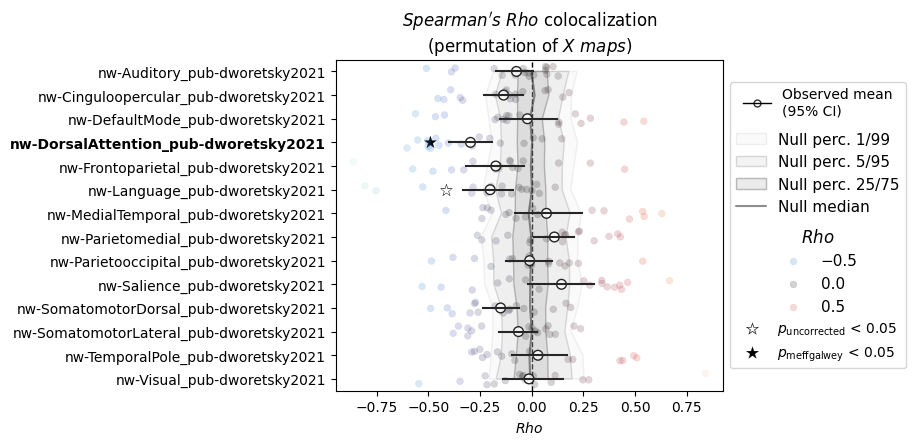
[5]:
(<Figure size 500x490 with 1 Axes>,
 <Axes: title={'center': "$Spearman's\\ Rho$ colocalization\n(permutation of $X\\ maps$)"}, xlabel='$Rho$'>,
 <seaborn._core.plot.Plotter at 0x1726adcd0>)
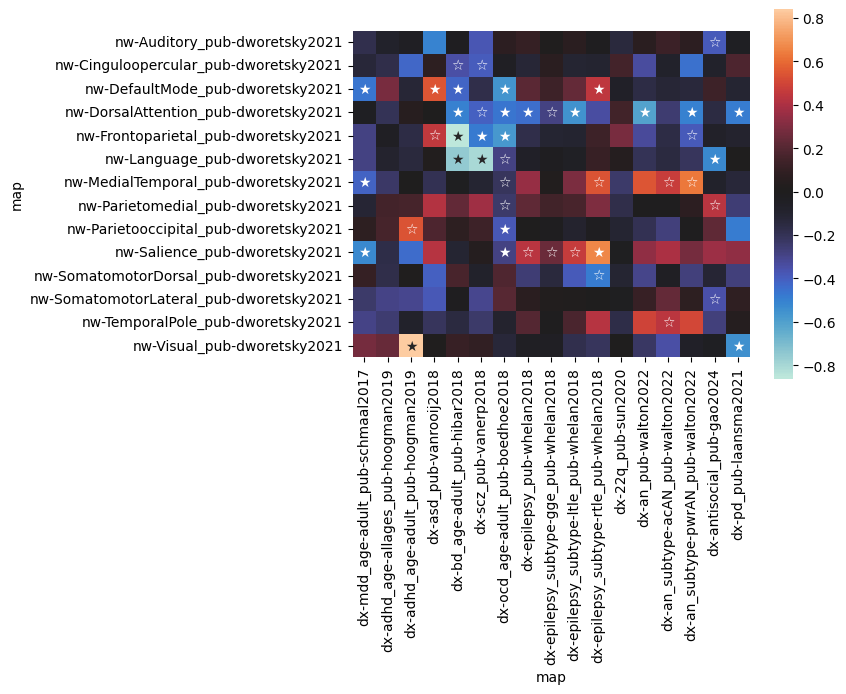
That is interesting in itself. But we might now want to know how each individual ENIGMA map colocalizes with each individual resting-state network.
To achieve that, we can set a flag in NiSpace.permute(), which deactivates the group-level p value computation.
[6]:
nsp.colocalize("spearman")
nsp.permute("maps", n_perm=1000, p_from_average_y_coloc=False)
nsp.correct_p()

# both the colocalization and the p value dataframes will now be a n_reference x n_enigma dataframe
colocs = nsp.get_colocalizations()
print(f"Colocalizations: {colocs.shape[0]} disorders x {colocs.shape[1]} receptors")
p_values = nsp.get_p_values()
pc_values = nsp.get_corrected_p_values()
print(f"P-Values: {p_values.shape[0]} disorders x {p_values.shape[1]} receptors")
Colocalizing (spearman, 4 proc): 100%|████████████████████████████████████████████████| 16/16 [00:00<00:00, 1460.51it/s]
INFO | 20/07/26 18:26:00 | nispace.core.permute: Found existing null maps.
INFO | 20/07/26 18:26:00 | nispace.core.permute: Z-standardizing null maps.
Processing null arrays (4 proc): 100%|████████████████████████████████████████████| 1000/1000 [00:00<00:00, 8255.06it/s]
Null colocalizations (spearman, 4 proc): 100%|████████████████████████████████████| 1000/1000 [00:00<00:00, 7780.76it/s]
INFO | 20/07/26 18:26:00 | nispace.core.permute: Calculating exact p-values (tails = {'rho': 'two'}).
Colocalizations: 16 disorders x 17 receptors
P-Values: 16 disorders x 17 receptors
A heatmap is a typical means to visualize this. For now, we just use seaborn.heatmap() and add the p values as annotation.
[7]:
import seaborn as sns

sns.heatmap(
    colocs.T,
    center=0,
    square=True,
    annot=((p_values.T < 0.05).astype(int) + (pc_values.T.astype(int) < 0.05)) \
        .replace({0: "", 1: "☆", 2: "★"}),
    fmt="s"
)
[7]:
<Axes: xlabel='map', ylabel='map'>
Individual-level deviation colocalization
Except for the last, the analyses so far have produced group-level results: one colocalization value per disorder or condition. But we often may want to compute colocalization for each subject individually.
The "zscore(a,b)" transform in transform_y() produces one deviation map per subject in group A (patients). We can then colocalize each map separately and look at the distribution across subjects.
This is particularly useful for stratifying patients by their colocalization profile (e.g., identifying subgroups with different neurotransmitter involvement).
We return to the anorexia nervosa example dataset here — as a reminder, it is simulated and not intended for scientific use.
[8]:
from nispace.datasets import fetch_example

an_data = fetch_example("anorexianervosa", parcellation="Yan200")
groups = an_data.index.str.extract(r'(AN|HC)$')[0].values

pet_s200 = fetch_reference("pet", parcellation="Yan200",
                           collection="UniqueTracers", print_references=False)

nsp_indiv = NiSpace(
    x=pet_s200,
    y=an_data,
    parcellation="Yan200",
    seed=42,
    n_proc=4
)
nsp_indiv.fit()

# compute z-scores: each AN patient mapped relative to HC mean and SD
nsp_indiv.transform_y("zscore(a,b)", groups=groups)

print(f"Individual z-score maps: {nsp_indiv.get_y().shape}")
INFO | 20/07/26 18:26:01 | nispace.datasets: Loading example dataset: 'anorexianervosa', parcellated with: Yan200.
INFO | 20/07/26 18:26:01 | nispace.datasets: Loading pet maps.
INFO | 20/07/26 18:26:01 | nispace.datasets: Loading integrated collection 'UniqueTracers' for dataset 'pet'.
INFO | 20/07/26 18:26:01 | nispace.datasets: Filtering maps by collection.
INFO | 20/07/26 18:26:01 | nispace.datasets: Loading data parcellated with 'Yan200'
INFO | 20/07/26 18:26:01 | nispace.core.parcellation: Building cortex Parcellation for 'Yan200' from library. DOI: 10.1016/j.neuroimage.2023.120010
INFO | 20/07/26 18:26:01 | nispace.core.parcellation: Available spaces: MNI152NLin2009cAsym, MNI152NLin6Asym, fsLR, fsaverage
INFO | 20/07/26 18:26:02 | nispace.core.parcellation: Parcellation 'Yan200': validation passed.
INFO | 20/07/26 18:26:02 | nispace.io: Input type: DataFrame, assuming parcellated data with shape (n_files/subjects/etc, n_parcels).
WARNING | 20/07/26 18:26:02 | nispace.io: Parcellated data contains nan values!
INFO | 20/07/26 18:26:02 | nispace.io: Input type: DataFrame, assuming parcellated data with shape (n_files/subjects/etc, n_parcels).
Individual z-score maps: (50, 200)
[9]:
# colocalize each subject's z-score map with PET maps
nsp_indiv.colocalize("spearman")

# result: one row per AN subject, one column per receptor
indiv_colocs = nsp_indiv.get_colocalizations()
print(f"Individual colocalizations: {indiv_colocs.shape}")
indiv_colocs.head(5)
Colocalizing (spearman, 4 proc): 100%|████████████████████████████████████████████████| 50/50 [00:00<00:00, 2449.69it/s]
Individual colocalizations: (50, 29)
[9]:
| set | General | Immunity | Glutamate | GABA | ... | Serotonin | Noradrenaline/Acetylcholine | Opioids/Endocannabinoids | Histamine | ||||||||||||
|---|---|---|---|---|---|---|---|---|---|---|---|---|---|---|---|---|---|---|---|---|---|
| map | target-CMRglu_tracer-fdg_n-20_dx-hc_pub-castrillon2023 | target-rCPS_tracer-leucine_n-42_dx-hc_pub-smith2023 | target-SV2A_tracer-ucbj_n-76_dx-hc_pub-finnema2016 | target-HDAC_tracer-martinostat_n-8_dx-hc_pub-wey2016 | target-VMAT2_tracer-dtbz_n-76_dx-hc_pub-larsen2020 | target-TSPO_tracer-pbr28_n-6_dx-hc_pub-lois2018 | target-COX1_tracer-ps13_n-11_dx-hc_pub-kim2020 | target-mGluR5_tracer-abp688_n-73_dx-hc_pub-smart2019 | target-NMDA_tracer-ge179_n-29_dx-hc_pub-galovic2021 | target-GABAa5_tracer-ro154513_n-10_dx-hc_pub-lukow2022 | ... | target-5HT6_tracer-gsk215083_n-30_dx-hc_pub-radhakrishnan2018 | target-5HTT_tracer-dasb_n-18_dx-hc_pub-savli2012 | target-NET_tracer-mrb_n-10_dx-hc_pub-hesse2017 | target-A4B2_tracer-flubatine_n-30_dx-hc_pub-hillmer2016 | target-M1_tracer-lsn3172176_n-24_dx-hc_pub-naganawa2020 | target-VAChT_tracer-feobv_n-18_dx-hc_pub-aghourian2017 | target-MOR_tracer-carfentanil_n-204_dx-hc_pub-kantonen2020 | target-KOR_tracer-ly2795050_n-28_dx-hc_pub-vijay2018 | target-CB1_tracer-omar_n-77_dx-hc_pub-normandin2015 | target-H3_tracer-gsk189254_n-8_dx-hc_pub-gallezot2017 |
| sub-001AN | -0.092801 | -0.139145 | -0.099534 | -0.099192 | -0.100787 | -0.121601 | 0.023633 | -0.084197 | -0.141287 | -0.103911 | ... | -0.038291 | -0.086561 | 0.112588 | -0.161887 | -0.086612 | -0.117442 | -0.052568 | -0.099537 | -0.059565 | -0.103858 |
| sub-002AN | -0.034211 | 0.026949 | -0.019551 | -0.051041 | -0.053727 | -0.109795 | -0.029288 | -0.018089 | -0.034735 | -0.040137 | ... | -0.036297 | -0.073508 | 0.054668 | 0.040792 | -0.023951 | 0.045505 | -0.039636 | 0.025413 | -0.130271 | 0.072158 |
| sub-003AN | 0.128289 | 0.037643 | 0.078281 | 0.156557 | 0.021494 | 0.008889 | 0.068417 | 0.081357 | 0.019581 | -0.038507 | ... | 0.102751 | -0.060989 | -0.019266 | 0.028036 | 0.104595 | -0.081773 | 0.001771 | -0.014571 | 0.013816 | 0.015680 |
| sub-004AN | -0.017879 | -0.108614 | -0.061209 | -0.044154 | -0.060982 | 0.013888 | -0.112908 | -0.047852 | -0.025143 | 0.003369 | ... | -0.000788 | -0.073638 | -0.011572 | -0.007290 | -0.021149 | 0.000519 | 0.041803 | 0.014025 | 0.033306 | 0.019823 |
| sub-005AN | 0.063341 | -0.070749 | 0.085257 | 0.061179 | 0.092429 | 0.030433 | -0.080497 | 0.112793 | 0.088098 | 0.100738 | ... | 0.005112 | 0.049605 | 0.057092 | 0.035009 | 0.063276 | 0.066334 | 0.098072 | -0.024295 | 0.070550 | 0.086762 |
5 rows × 29 columns
[10]:
# for permutation testing with individual maps, we permute group labels
# p values are computed for the MEAN colocalization across subjects by default
#  -> compare to the section above
nsp_indiv.permute("groups", groups=groups, n_perm=1000)
nsp_indiv.correct_p()
p_indiv = nsp_indiv.get_p_values()

print(f"P-values shape: {p_indiv.shape}")
print(p_indiv.T.sort_values(by=p_indiv.index[0]).head(10))
INFO | 20/07/26 18:26:02 | nispace.core.parcellation: Lazy-loading parcellation image for space 'fsLR'.
Permuting groups (4 proc): 100%|████████████████████████████████████████████████| 1000/1000 [00:00<00:00, 571119.83it/s]
Null transformations (spearman, 4 proc): 100%|███████████████████████████████████| 1000/1000 [00:00<00:00, 13600.65it/s]
Processing null arrays (4 proc): 100%|████████████████████████████████████████████| 1000/1000 [00:00<00:00, 6388.56it/s]
Null colocalizations (spearman, 4 proc): 100%|█████████████████████████████████████| 1000/1000 [00:01<00:00, 957.59it/s]
INFO | 20/07/26 18:26:04 | nispace.core.permute: Calculating exact p-values (tails = {'rho': 'two'}).
P-values shape: (1, 29)
                                                               mean
set       map
Dopamine  target-DAT_tracer-fpcit_n-174_dx-hc_pub-dukart2018  0.001
Serotonin target-5HT1a_tracer-way100635_n-35_dx-hc_pub-sa...  0.001
Dopamine  target-D23_tracer-flb457_n-55_dx-hc_pub-sandieg...  0.001
Immunity  target-TSPO_tracer-pbr28_n-6_dx-hc_pub-lois2018     0.001
Dopamine  target-D1_tracer-sch23390_n-13_dx-hc_pub-kaller...  0.001
          target-FDOPA_tracer-fluorodopa_n-12_dx-hc_pub-g...  0.001
Serotonin target-5HTT_tracer-dasb_n-18_dx-hc_pub-savli2012    0.001
GABA      target-GABAa5_tracer-ro154513_n-10_dx-hc_pub-lu...  0.001
General   target-VMAT2_tracer-dtbz_n-76_dx-hc_pub-larsen2020  0.002
Serotonin target-5HT2a_tracer-altanserin_n-19_dx-hc_pub-s...  0.004
[11]:
# plot
nsp_indiv.plot()
INFO | 20/07/26 18:26:04 | nispace.plotting: Significance annotation: 16/29 p_uncorrected < 0.05, 11/29 p_meffgalwey < 0.05
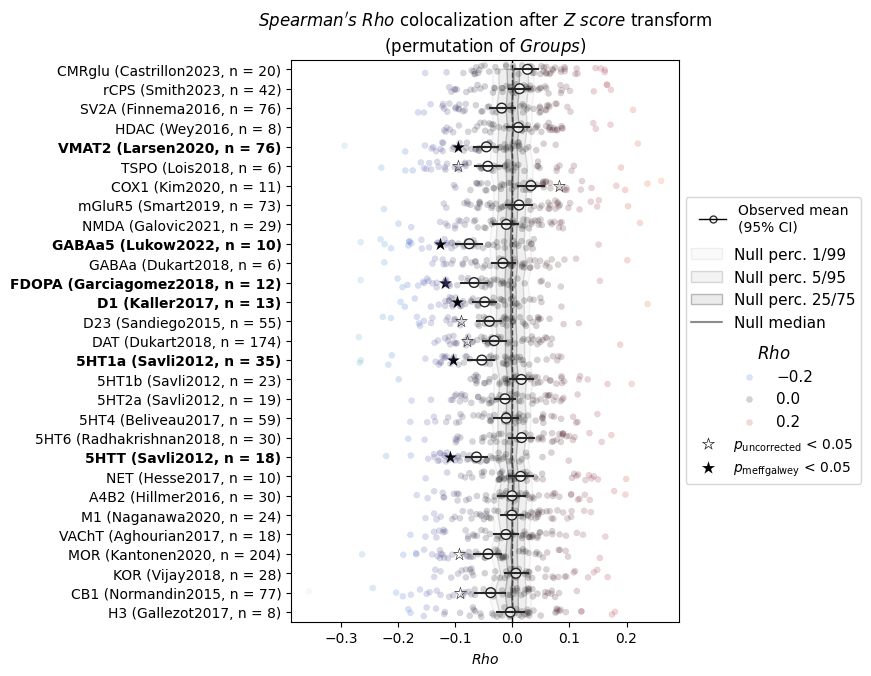
[11]:
(<Figure size 500x730 with 1 Axes>,
 <Axes: title={'center': "$Spearman's\\ Rho$ colocalization after $Z\\ score$ transform\n(permutation of $Groups$)"}, xlabel='$Rho$'>,
 <seaborn._core.plot.Plotter at 0x308ecbf70>)
Dimensionality reduction with reduce_x()
When you have many reference maps (30 PET tracers, thousands of genes), interpreting individual colocalizations can be difficult — and many maps are correlated with each other. reduce_x() summarizes the reference maps into a smaller set of components using PCA, ICA, or factor analysis.
After reduction, colocalize() operates on the components instead of individual maps.
[12]:
# reduce the PET maps to their principal components
nsp.reduce_x("pca", n_components=5)  # keep 5 components

# colocalize on the reduced space
nsp.colocalize("spearman", X_reduction="pca")
nsp.permute("maps", n_perm=1000, X_reduction="pca")

pca_colocs = nsp.get_colocalizations(X_reduction="pca")
print(f"PCA colocalizations: {pca_colocs.shape[0]} disorders x {pca_colocs.shape[1]} components")
pca_colocs
INFO | 20/07/26 18:26:04 | nispace.core.reduce_x: Performing dimensionality reduction using pca (max components: 5, min EV: None).
INFO | 20/07/26 18:26:04 | nispace.core.reduce_x: Returning 5 principal component(s).
Colocalizing (spearman, 4 proc): 100%|████████████████████████████████████████████████| 16/16 [00:00<00:00, 1378.23it/s]
INFO | 20/07/26 18:26:04 | nispace.core.permute: Found existing null maps.
WARNING | 20/07/26 18:26:04 | nispace.core.permute: 5 map(s) missing from null map cache. Will re-generate.
INFO | 20/07/26 18:26:04 | nispace.core.permute: Generating null maps (n = 1000, null_method = 'moran').
INFO | 20/07/26 18:26:04 | nispace.nulls: Null map generation: Assuming n = 5 data vector(s) for n = 68 parcels.
INFO | 20/07/26 18:26:04 | nispace.nulls: Using provided distance matrix/matrices.
Moran null maps (4 proc): 100%|█████████████████████████████████████████████████████████| 5/5 [00:00<00:00, 3182.81it/s]
INFO | 20/07/26 18:26:05 | nispace.nulls: Null data generation finished.
INFO | 20/07/26 18:26:05 | nispace.core.permute: Z-standardizing null maps.
Processing null arrays (4 proc): 100%|████████████████████████████████████████████| 1000/1000 [00:00<00:00, 8554.83it/s]
Null colocalizations (spearman, 4 proc): 100%|███████████████████████████████████| 1000/1000 [00:00<00:00, 11437.07it/s]
INFO | 20/07/26 18:26:05 | nispace.core.permute: Calculating exact p-values (tails = {'rho': 'two'}).
PCA colocalizations: 16 disorders x 5 components
[12]:
| c0 | c1 | c2 | c3 | c4 | |
|---|---|---|---|---|---|
| map | |||||
| dx-mdd_age-adult_pub-schmaal2017 | 0.360650 | -0.211170 | -0.454443 | 0.068659 | -0.018488 |
| dx-adhd_age-allages_pub-hoogman2019 | -0.057997 | -0.345816 | -0.293569 | -0.121616 | 0.010564 |
| dx-asd_pub-vanrooij2018 | -0.395074 | 0.118303 | 0.152678 | -0.104318 | 0.226515 |
| dx-bd_age-adult_pub-hibar2018 | 0.457589 | -0.501677 | 0.253697 | -0.131245 | 0.081823 |
| dx-scz_pub-vanerp2018 | 0.166803 | -0.478120 | 0.308127 | 0.002171 | 0.157909 |
| dx-ocd_age-adult_pub-boedhoe2018 | 0.496552 | -0.134681 | -0.072331 | -0.268401 | -0.244831 |
| dx-epilepsy_pub-whelan2018 | -0.197575 | -0.074140 | 0.351701 | -0.319496 | 0.104093 |
| dx-epilepsy_subtype-gge_pub-whelan2018 | -0.077951 | -0.009747 | 0.247212 | -0.396098 | 0.093179 |
| dx-epilepsy_subtype-ltle_pub-whelan2018 | -0.272236 | -0.061233 | 0.273404 | -0.371563 | 0.086673 |
| dx-epilepsy_subtype-rtle_pub-whelan2018 | -0.553774 | 0.053973 | 0.384886 | -0.209051 | 0.085322 |
| dx-22q_pub-sun2020 | 0.065742 | 0.231574 | -0.133770 | 0.130121 | 0.147505 |
| dx-an_pub-walton2022 | -0.143179 | -0.198701 | 0.314056 | -0.198576 | -0.073153 |
| dx-an_subtype-acAN_pub-walton2022 | -0.093040 | -0.003934 | 0.460663 | -0.029153 | -0.078482 |
| dx-an_subtype-pwrAN_pub-walton2022 | -0.178705 | -0.297488 | 0.278976 | -0.159790 | -0.002936 |
| dx-antisocial_pub-gao2024 | 0.144558 | -0.135208 | 0.201037 | -0.008064 | 0.615869 |
| dx-pd_pub-laansma2021 | 0.011523 | 0.140219 | 0.122293 | -0.527748 | -0.017193 |
[13]:
nsp.plot(X_reduction="pca")
INFO | 20/07/26 18:26:05 | nispace.plotting: Significance annotation: 1/5 p_uncorrected < 0.05, 0/5 p_meffgalwey < 0.05 (no correction applied)
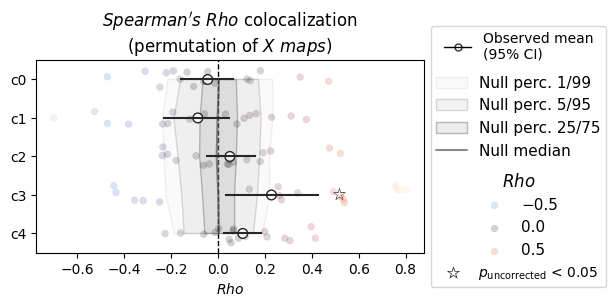
[13]:
(<Figure size 500x250 with 1 Axes>,
 <Axes: title={'center': "$Spearman's\\ Rho$ colocalization\n(permutation of $X\\ maps$)"}, xlabel='$Rho$'>,
 <seaborn._core.plot.Plotter at 0x33bd1c880>)
Alternative colocalization methods
Spearman correlation is the default, but NiSpace supports several other methods. Each has different assumptions and use cases.
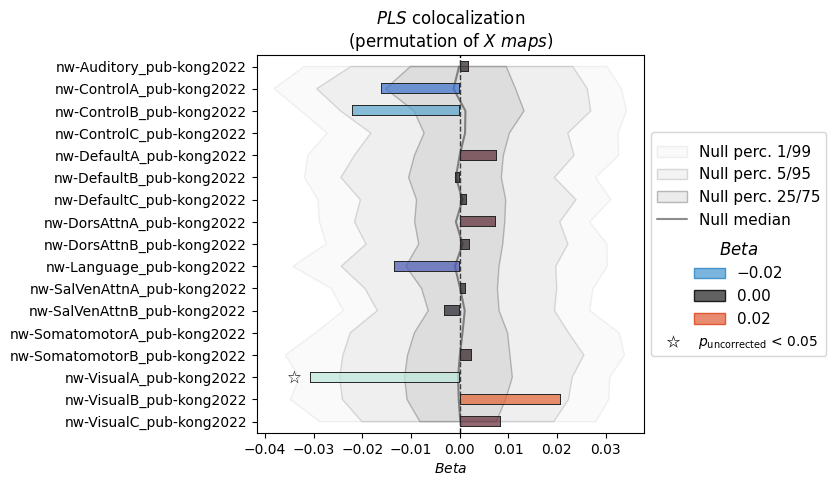
Importantly, methods might return multiple different colocalization metrics. For example, a linear regression model ("mlr") already returns both beta coefficients (one for each X map, as for correlations) and the R^2 value (one across X maps). Each of these colocalization statistics will furthermore have an associated p values after .permute() has been run.
[14]:
# set up a simple analysis for comparison
nsp_methods = NiSpace(
    x=rsn17_maps,
    y=enigma_thick.loc[["dx-bd_age-adult_pub-hibar2018"]],  # just bipolar disorder for clarity
    parcellation="DesikanKilliany",
    seed=42
)
nsp_methods.fit()

# Pearson correlation
nsp_methods.colocalize("pearson")
pearson = nsp_methods.get_colocalizations()
print("Pearson:", pearson.values.squeeze())
print("")

# Multiple linear regression (MLR)
nsp_methods.colocalize("mlr")
mlr = nsp_methods.get_colocalizations()
print("MLR beta:", mlr["beta"].values.squeeze())
print("MLR R2:", mlr["r2"].values.squeeze())
print("")

# Partial least squares (PLS)
nsp_methods.colocalize("pls", n_components=3)
pls = nsp_methods.get_colocalizations()
print("PLS beta:", pls["beta"].values.squeeze())
print("PLS R2:", pls["r2"].values.squeeze())
print("")

# Dominance analysis (takes the longest)
nsp_methods.colocalize("dominance")
dom = nsp_methods.get_colocalizations()
print("Dominance: sum (matches MLR R2) :", dom["sum"].values.squeeze())
print("Dominance: total (sum of total is MLR R2):", dom["total"].values.squeeze())
print("Dominance: individual (like a leave-one-out MLR R2):", dom["individual"].values.squeeze())
print("Dominance: relative (fraction of sum R2):", dom["relative"].values.squeeze())
INFO | 20/07/26 18:26:05 | nispace.core.parcellation: Building cortex Parcellation for 'DesikanKilliany' from library. DOI: 10.1016/j.neuroimage.2006.01.021
INFO | 20/07/26 18:26:05 | nispace.core.parcellation: Available spaces: MNI152NLin2009cAsym, MNI152NLin6Asym, fsLR, fsaverage
INFO | 20/07/26 18:26:06 | nispace.core.parcellation: Parcellation 'DesikanKilliany': validation passed.
INFO | 20/07/26 18:26:06 | nispace.io: Input type: DataFrame, assuming parcellated data with shape (n_files/subjects/etc, n_parcels).
INFO | 20/07/26 18:26:06 | nispace.io: Input type: DataFrame, assuming parcellated data with shape (n_files/subjects/etc, n_parcels).
Colocalizing (pearson, 1 proc): 100%|████████████████████████████████████████████████████| 1/1 [00:00<00:00, 204.67it/s]
Pearson: [ 0.06299942 -0.5719506  -0.48250383  0.01724178  0.16799776 -0.20048994
  0.10904669 -0.18606009  0.04795838 -0.3314443   0.04847691 -0.23567176
  0.13917491  0.15214008 -0.23653209  0.4126434   0.13605513]
Colocalizing (mlr, 1 proc): 100%|████████████████████████████████████████████████████████| 1/1 [00:00<00:00, 120.67it/s]
MLR beta: [ 0.06792119 -0.01860249  0.0106711   0.0244113   0.03303479  0.04273786
  0.02695448  0.04961617 -0.00843902  0.00987888  0.0057653   0.02717505
  0.06151685  0.03901247 -0.01884886  0.09041714  0.04204404]
MLR R2: 0.08892989
Colocalizing (pls, 1 proc): 100%|████████████████████████████████████████████████████████| 1/1 [00:00<00:00, 102.95it/s]
PLS beta: [ 2.0041761e-03 -1.6259542e-02 -2.2138054e-02  1.6468605e-04
  7.5916052e-03 -9.2356192e-04  1.4484321e-03  7.4772104e-03
  2.1116403e-03 -1.3464274e-02  1.3941166e-03 -3.1699201e-03
  8.5434360e-05  2.4655869e-03 -3.0783098e-02  2.0868970e-02
  8.5071260e-03]
PLS R2: 0.5273024
Colocalizing (dominance, 1 proc): 100%|███████████████████████████████████████████████████| 1/1 [00:05<00:00, 5.31s/it]
Dominance: sum (matches MLR R2) : -5.6413383
Dominance: total (sum of total is MLR R2): [-0.3582054  -0.253004   -0.26643303 -0.36372048 -0.34428048 -0.35236186
 -0.36082304 -0.346657   -0.36318967 -0.31780437 -0.36006957 -0.34669048
 -0.35836783 -0.3574694  -0.26711085 -0.28469688 -0.34045407]
Dominance: individual (like a leave-one-out MLR R2): [-0.01113302  0.2559675   0.18881793 -0.01484976  0.01296868  0.02458442
 -0.00317526  0.01919597 -0.01282031  0.08868193 -0.01276945  0.03920722
  0.00426024  0.00798787  0.03959062  0.13981932  0.00341059]
Dominance: relative (fraction of sum R2): [0.06349653 0.04484822 0.04722869 0.06447414 0.06102816 0.06246068
 0.06396054 0.06144943 0.06438005 0.05633492 0.06382698 0.06145536
 0.06352532 0.06336606 0.04734884 0.05046619 0.06034987]
If we plot multi-outcome colocalization results, we will automatically get one plot for each metric. E.g., for the quite detailled dominance output:
[15]:
# first: run the proper permutation; will take some time for dominance analysis
nsp_methods.permute("maps", method="pls", n_perm=1000, n_proc=4)
nsp_methods.correct_p(coloc_method="pls")

# show
nsp_methods.plot()
INFO | 20/07/26 18:26:11 | nispace.core.parcellation: Lazy-loading parcellation image for space 'fsLR'.
INFO | 20/07/26 18:26:11 | nispace.core.permute: Generating null maps (n = 1000, null_method = 'moran').
INFO | 20/07/26 18:26:11 | nispace.nulls: Null map generation: Assuming n = 17 data vector(s) for n = 68 parcels.
INFO | 20/07/26 18:26:11 | nispace.nulls: Using provided distance matrix/matrices.
Moran null maps (4 proc): 100%|████████████████████████████████████████████████████████| 17/17 [00:00<00:00, 152.27it/s]
INFO | 20/07/26 18:26:11 | nispace.nulls: Null data generation finished.
INFO | 20/07/26 18:26:11 | nispace.core.permute: Z-standardizing null maps.
Null colocalizations (pls, 4 proc): 100%|████████████████████████████████████████| 1000/1000 [00:00<00:00, 20119.85it/s]
INFO | 20/07/26 18:26:11 | nispace.core.permute: Calculating exact p-values (tails = {'r2': 'upper', 'beta': 'two'}).
INFO | 20/07/26 18:26:11 | nispace.plotting: Significance annotation: 0/1 p_uncorrected < 0.05, 0/1 p_meffgalwey < 0.05
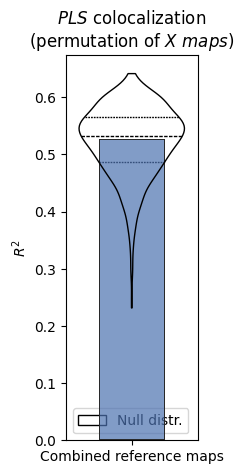
INFO | 20/07/26 18:26:12 | nispace.plotting: Significance annotation: 1/17 p_uncorrected < 0.05, 0/17 p_meffgalwey < 0.05
[15]:
{'r2': (<Figure size 170x500 with 1 Axes>,
  <Axes: title={'center': '$PLS$ colocalization\n(permutation of $X\\ maps$)'}, ylabel='$R^2$'>,
  <seaborn._core.plot.Plotter at 0x3438afd30>),
 'beta': (<Figure size 500x490 with 1 Axes>,
  <Axes: title={'center': '$PLS$ colocalization\n(permutation of $X\\ maps$)'}, xlabel='$Beta$'>,
  <seaborn._core.plot.Plotter at 0x34364fe50>)}
Summary
Feature |
How to use |
|---|---|
Individual-level colocalization |
|
Individual-level deviation colocalization |
|
Dimensionality reduction |
|
Alternative colocalization methods |
|
This is the last notebook in the introduction series. For more, see the API reference and the Example notebooks.